

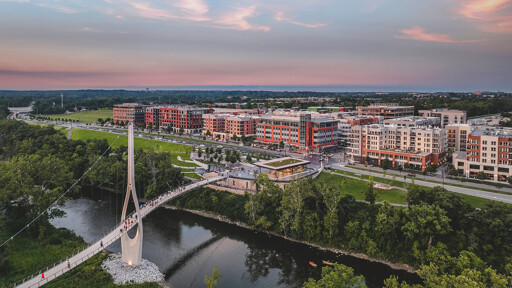
Like many American communities, Dublin, Ohio, grew from a small rural town in the 19th century into a sprawling suburb in the 20th. Today, it’s embracing a 21st-century development trend: walkability.
An affluent suburb of the Ohio capital, Columbus, Dublin is home to roughly 50,000 people. In recent years, the local government has shepherded the development of a walkable new neighborhood, Bridge Park, and built an attractive pedestrian bridge connecting it to the historic town center. Building on the success of this development, in 2024 the city council announced another ambitious project that will turn a 1980s office park into a walkable district with housing, shops, restaurants, public spaces, and workplaces.
Projects that aim to transform traditional suburban environments are increasingly common in the United States. Ellen Dunham-Jones and June Williamson, architecture professors at Georgia Tech and the City College of New York, respectively, have been writing about similar efforts, which they call suburban retrofits, for almost two decades. In that time, they’ve seen massive growth in both the number of these projects and the level of ambition they display, with innovative strategies taking on issues like public health, aging populations, equity, jobs, and climate change, all while reducing car dependency.