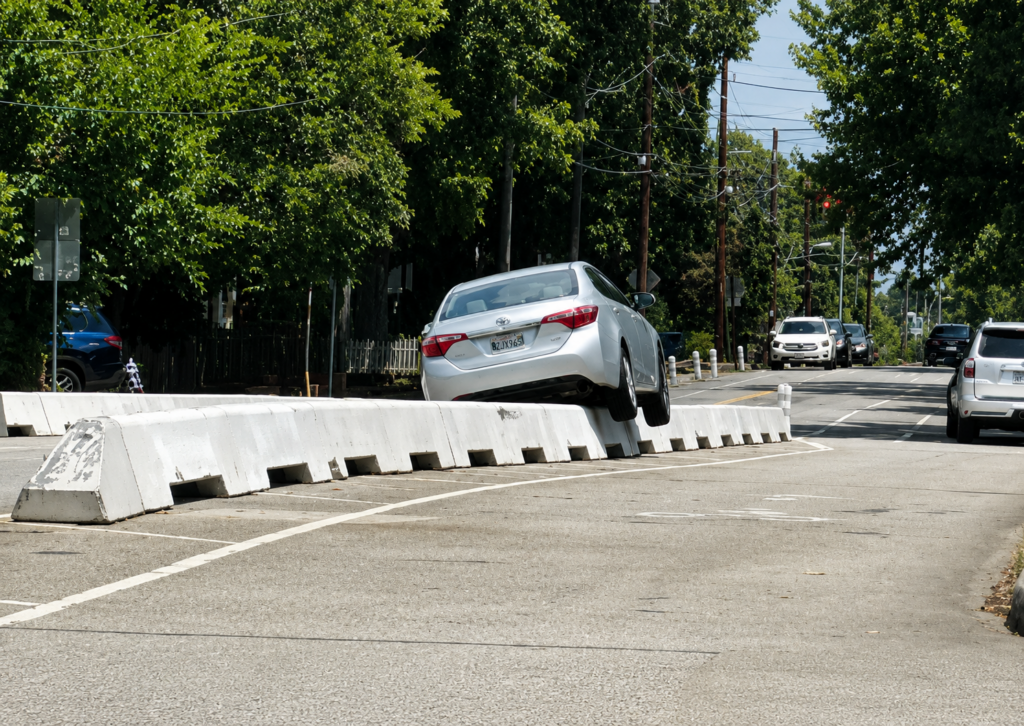
If you drive down Cherokee Avenue in Atlanta's Grant Park neighborhood and see a car precariously balanced on two wheels atop a concrete divider, don't
If you consult the CROW manual for bicycle traffic, which is what the Netherlands uses as a guide for road design (and is where the design you’re talking about came from), you will see that there are certain constraints on when various designs should be used:
The street’s speed limit and motor vehicle traffic volume have to be low enough, and it matters what category the road has been classified as in both the motor vehicle traffic network and the bicycle traffic network. Since instead of just thinking about roads individually, their place in the larger system is considered:
(This is the bicycle network of Amsterdam)
The width of the throughway and whether there is enough room to fit the infrastructure for a given combination of network links within it is also important. That’s another reason why it’s best to plan the networks holistically, to make the best use of all available space on multiple adjacent roadways.
Of course if you decrease car traffic volumes and speeds to a low enough level (by making other transit modes more attractive, making more of the urban area mixed use, etc) you can start using the higher categories in the above chart more. But the standards in the Netherlands are not so simple as “just put some paint down anywhere and it’ll work so long as the drivers are educated”. And that’s without even getting into how they design roads to enforce their own limits on speed and traffic volumes, using things like chicanes and modal filters. So, some amount of effort goes into creating the conditions that make such a design safe, rather than the drivers just deciding to do it themselves.

If you consult the CROW manual for bicycle traffic, which is what the Netherlands uses as a guide for road design (and is where the design you’re talking about came from), you will see that there are certain constraints on when various designs should be used:
The street’s speed limit and motor vehicle traffic volume have to be low enough, and it matters what category the road has been classified as in both the motor vehicle traffic network and the bicycle traffic network. Since instead of just thinking about roads individually, their place in the larger system is considered:
(This is the bicycle network of Amsterdam)
The width of the throughway and whether there is enough room to fit the infrastructure for a given combination of network links within it is also important. That’s another reason why it’s best to plan the networks holistically, to make the best use of all available space on multiple adjacent roadways.
Of course if you decrease car traffic volumes and speeds to a low enough level (by making other transit modes more attractive, making more of the urban area mixed use, etc) you can start using the higher categories in the above chart more. But the standards in the Netherlands are not so simple as “just put some paint down anywhere and it’ll work so long as the drivers are educated”. And that’s without even getting into how they design roads to enforce their own limits on speed and traffic volumes, using things like chicanes and modal filters. So, some amount of effort goes into creating the conditions that make such a design safe, rather than the drivers just deciding to do it themselves.