I waited tables for 5 years quite some time ago. I never had someone skip out on the total bill, but I did get a few of these as a “tip”. Since I’m in the US, I actually lost money on those tables since we had to pay a flat percentage of our “sales” into a pool that was split between other front of house staff.
It was a bigger place that would staff for surges in customers. “Better” WWs would get better sections and shifts, so you would stay busier longer despite dips in overall volume. Not to mention more consistent tips.
This all created an incentive to be decent at your job, which involved a mix of knowing the menu, how to interact with customers, and multitasking/path optimization to turn your tables. I routinely did 20,000 to 30,000 steps a shift. Not everyone figured it out or wanted to do that amount of work, so the low end of the staff had a decent amount of turnover.
On the higher end of the scale you could clear $200-$300/shift working in casual dining, depending on the day of the week, without any education barriers. That’s $20-30/hour or $42-$60k/year. You weren’t getting rich, but that’s enough to put you around median income levels. There were lifers who had been doing it for decades.
I don’t see a shift to hourly pay making up the difference for the higher earners.


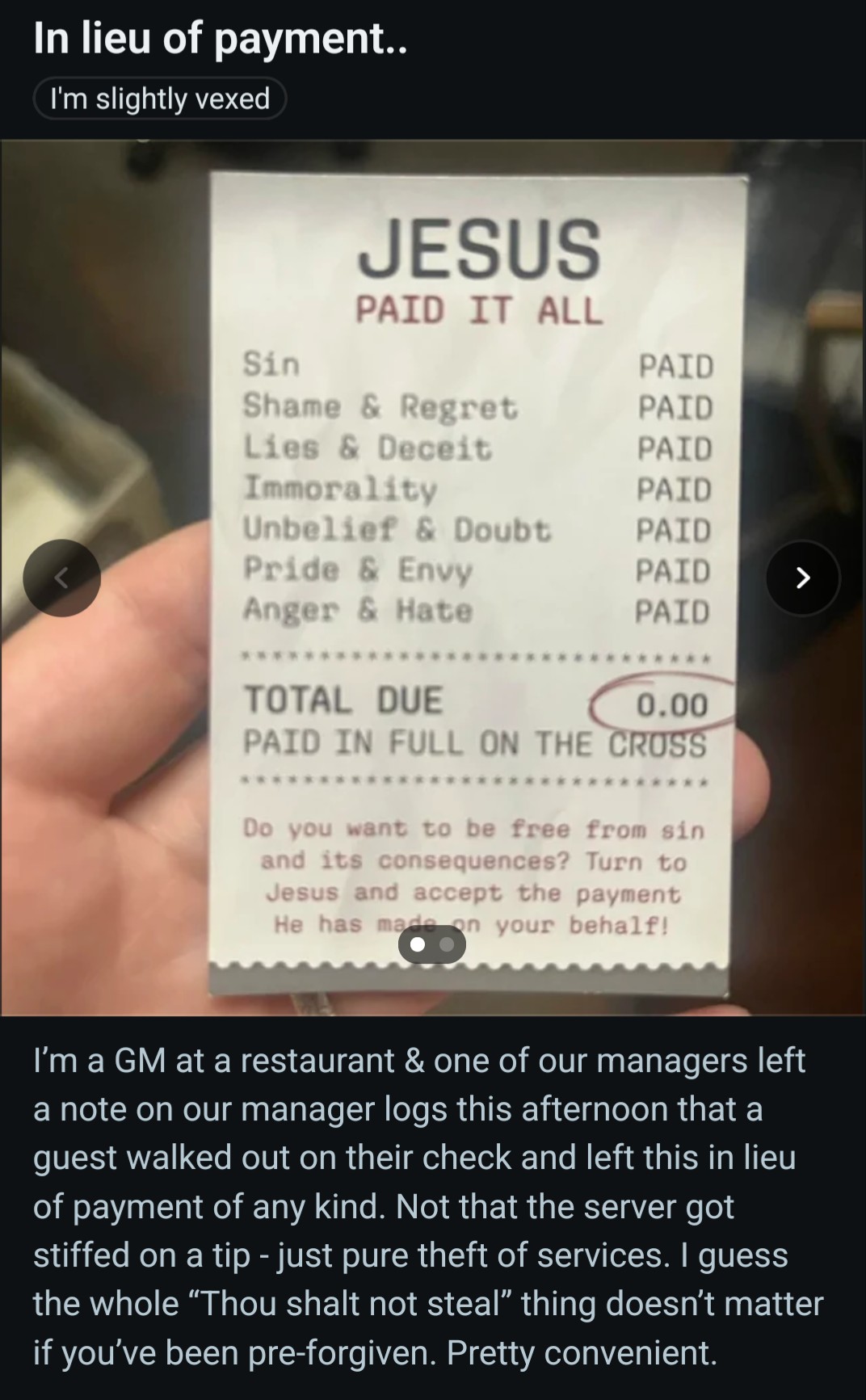
I waited tables for 5 years quite some time ago. I never had someone skip out on the total bill, but I did get a few of these as a “tip”. Since I’m in the US, I actually lost money on those tables since we had to pay a flat percentage of our “sales” into a pool that was split between other front of house staff.
What a stupid system.
I have very mixed feelings about it TBH.
It was a bigger place that would staff for surges in customers. “Better” WWs would get better sections and shifts, so you would stay busier longer despite dips in overall volume. Not to mention more consistent tips.
This all created an incentive to be decent at your job, which involved a mix of knowing the menu, how to interact with customers, and multitasking/path optimization to turn your tables. I routinely did 20,000 to 30,000 steps a shift. Not everyone figured it out or wanted to do that amount of work, so the low end of the staff had a decent amount of turnover.
On the higher end of the scale you could clear $200-$300/shift working in casual dining, depending on the day of the week, without any education barriers. That’s $20-30/hour or $42-$60k/year. You weren’t getting rich, but that’s enough to put you around median income levels. There were lifers who had been doing it for decades.
I don’t see a shift to hourly pay making up the difference for the higher earners.
High earners can still make tips on an hourly pay.
Hourly pay does not exclude tipping.
You’re not wrong, I just wonder what the net impact would be. Working for $2.13/hour was… very dumb.