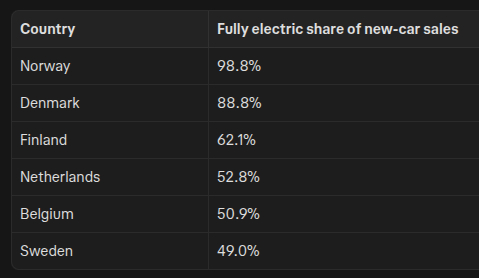
Norway 98%
Others: EVs dont work in the cold.
No one thinks EVs don’t work in the cold, they just have severely shortened range. Which means you need a bigger battery, which means a heavier and more expensive vehicle. You also need faster and more frequent chargers. This is similar to the “Electric trucks can’t tow” strawman. They absolutely can, just not very far . Either is a legitimate reason not to purchase an EV. As stated in the OP, these are wealthy nations where the government is heavily invested, which is smart, but the same doesn’t apply everywhere.
Having driven electric vehicles in norway in the winter (-20C avg) i can safely inform you their range is not noticeably shortened, even blasting the heat.
Also my diesel which normally gets 50mpg drops to 20-25 when towing.
🤷
Maybe don’t eat the slop the talking heads are paid to shovel into the trough.
The alarms and “safety features” on new cars are annoying af though. Driving my 2009 into the ground.
I’m Norwegian, and I regularily drive a EV a good distance to visit my parents. I can inform you that the range is indeed reduced noticabily in the winter.
My route is around 350km and includes crossing over a mountain range. My EV has a range of around 300km, which is on the lower end for EVs. In the summer, I can make the trip with a single charging stop around midway. During the winter, I need to charge at least twice during that trip.
It’s not that I mind charging an additional time, but let’s be honest about how temperature affects range.
Maybe Ford did something crazy with their 2025 EVs? I was getting 300km of the stated 350… E18/E6 clear weather dry asphalt. So pretty ideal conditions other than cold.
My route is Road 134 over Haukelifjell which could be heavily affected by other driving conditions. But even when I drive on cold days with no other particular conditions, the battery percent drops a lot quicker.
Having driven electric vehicles in 10 Texas Winters, and also paying attention to some basic science, I can assure you it absolutely is.
Also my diesel which normally gets 50mpg drops to 20-25 when towing.
No one cares when there’s 3 fueling stations per mile and it only takes 5 minutes to refuel.
Maybe don’t eat the slop the talking heads are paid to shovel into the trough.
Maybe stop fucking lying 🤷
No one cares when there’s 3 fueling stations per mile
You’re not in Norway.
I live in norway and drive an EV. There are a lot of chargers around, and the infrastructure has adapted to EVs being the norm. Most gas stations offer charging and small charging stations are popping up in many other parking lots. Maybe not multiple stations per mile, but enough to never having to be worried about not being able to reach the next charger.
You’re correct, I’m not.
The science is the range indicator can say a lower number when the battery is cold. But you get your range back once the battery heats up. Thermal management is really good on recent models. Doesn’t really matter because it’s rare to drive 300+km in a day even in the US.
It doesn’t matter if you’re driving 45min to work, your car was charged overnight and most workplaces offer charging.
No one cares when there’s 3 fueling stations per mile and it only takes 5 minutes to refuel.
I certainly do at ~$12/gal.
The science is the range indicator can say a lower number when the battery is cold. But you get your range back once the battery heats up
I’d love to see that science.
It doesn’t matter if you’re driving 45min to work, your car was charged overnight
No one cares about range on their commute to work…
Because clearly articles like this wouldn’t exist of NO ONE thought they didnt work in the cold
Do EVs Work in Cold Weather?
https://www.greencarfuture.com/electric/why-evs-dont-work-in-cold-weather
"Electric vehicles do not work in the winter”: Exploring the role of misperceptions and socio-psychological factors in zero-emission vehicle adoption
https://www.sciencedirect.com/science/article/pii/S2214629625005316
“Electric vehicles do not work in the winter” is one of the misperceptions affecting interests in low-carbon transportation and hindering the electrification of passenger transportation. This study aimed to examine the role of misperceptions of battery electric vehicles and socio-psychological factors in influencing zero-emission vehicle adoption with empirical evidence from Saskatchewan, Canada.
You mean articles talking about how supposed misconceptions are wrong? How about find one that says it in the affirmative?
NotMyOldRedditName is responding to your statement that no one thinks EVs don’t work in the cold, not whether the idea of “working” or shortened range is correct.
…yes? I understood that.
I read somewhere that almost 50% of all car sales are electric now. Not that electric cars are some panacea, but I for one think ICE should go the way of the dinosaur.
The combustion engine will remain longer for a lot of heavier diesel vehicles I think, but as for most gasoline cars, EVs should take over rapidly.
But where did you get that money Norway? Hmmm?
Invested their oil wealth in a massive highly diverse sovereign wealth fund generations ago.
Nothing was stopping other countries from doing the same thing. But state investment is “ARGFFHG SOCIALISM BZZZZTT WANT TO BE LIKE VENEZUELA??” so we didn’t.
Nothing was stopping other countries from doing the same thing.
Except for having large quantities of oil, conveniently discovered after the country was stable and industrialized.
France has very little oil and EV purchases this summer hit around 45%. So it’s doable. High oil prices helps ofc :-)
The US also has lots of oil
That is totally correct
Indeed. It’s almost like my comment was aimed squarely at certain countries. My own UK and the USA being particularly in mind.
money for what? EVs are not more expensive than fossil cars
I don’t accept your premise but: EV subsidies, EV infrastructure, social programmes
Norway went the other way. They taxed fossil fuel cars at 100%.
It’s always this same group of countries doing awesome shit.
I need to move.
As someone who moved to one of them years ago from the US, it’s fucking sick: 10/10 recommend.
How hard is it to learn the language?
Um I’d say fairly hard, and I’m decently conversational in Spanish and my japanese is ~N4 level. It’s a really specific language (danish) so small mistakes make it basically unintelligible. But the actual language is very simple.
It’s not anywhere near as necessary as a lot of other places in the world though, since many people here speak English really well. But it’s definitely important for long term prospects here and anywhere else you are.
It’s a stress point among many when living somewhere besides your home country, for sure!
Any advice to share?
To move or to visit? Yes, either way
To move. I’m planning to take a vacation to the Netherlands to see if I can fit in with the culture after I graduate, and then work towards finding a job there if I like it. The EU is putting a lot of effort into promoting and adopting open source as part of digital sovereignty, and I want to be a part of that movement. I’d be curious to hear what your experiences were like moving to another country.
Yeah! Open source wise you’re absolutely correct. It’s obviously not perfect (and I’m in Denmark, not the Netherlands) but there’s so much less tech dystopia here than the US.
Um yeah, there’s a lot to say! It’s hard for many reasons, logistics, distance from family and friends, cultural differences. I guess the main things are keeping a (gainful) job for a visa (I mean I had that pressure for money and healthcare in the US, so I’m used to it). Learning a language and culture. Dealing with dark winters. Being a foreigner at a time when many countries are being less inviting to them. But all the upsides are amazing and plentiful! It’s so worth, but man it’s not for the faint of heart
Thanks for sharing, that confirms a lot of my suspicions. I’m well aware it’ll probably be one of the hardest things I’ll ever do in my life, but I feel like its one of the few places that has a hopeful future. Not having anyone to rely on is the thing I dread the most, especially for things like emergency situations. I’m gonna have to put a lot of effort into meeting new people, making friends, and building a new support network. It’s a daunting task.
Yes to everything you’ve said. The good news is that plenty of other people who have moved there from other places are in the same position to want to make friends. And there’s loads of clubs and activities and organizations to become a part of. All of which are great ways to make community!
But yeah it’s straight up hard often times. It gets way easier though. People are often surprised when I say it took a full year or a little longer to get settled
Stay right on escalators. Swedes are very passionate about that.
Man being born in one of these countries currently is just a luxury, especially Denmark and Norway
I gotta say, for all the dumb shit we’re dealing with, it’s pretty terrific in Denmark.
Germany: 34.5% because the government and the people are stuck in last century. It is ridiculous and incomprehensible.
Also because the car companies there denied that electric vehicles were going to happen for eons. I’m not even sure some of them have accepted it even now.
It’s only 49% in Sweden because of the braindead right wing government we’ve had for the past 4 years.
They lost the election though so maybe we can still right the ship
What about just not buying cars? The most environmentally freindly countries are apparently does that just cant afford the western way of life. Why cant we have walfare, social security, etc while having good urbanism and low car usage?
Sweden and Norway have quite low population densities, and Norway especially is very difficult in terms of building infrastructure. Fjords and mountains are beautiful, but they’re a nightmare to build any kind of infrastructure for. So it will be a lot of dirt roads, sharp turns et.c. and not suitable for rail.
That being said, urban centers should likely be almost entirely car-free.
Yeah but like 60% of the population is in large urban centers and theyre already connected in norway by huge road tunnels and bridges, they could have trains as well. As for sweden, the government just doesnt spend money on public transit and when it does they throw it away on random stuff. Many tracks are in disrepair, out of use and the main high speed lines are constructed in stupid places. There are like 2 population corridors that make up 50% of swedens total population, thats three good highspeed lines to connect them but even that isnt achieved in a reliable way. As for transport within cities, apart from gothenburg and stockholm its pretty bad as well.
It’s not better in Norway. There’s always something wrong with the trains. There’s been abysmal punctuality or cancellation numbers that would make even German train operators blush. They’re on partial strike at the moment and although there are many cancellations I hardly notice any difference between a planned disruption by strike and an unplanned disruption by mismanagement.
And biking in urban centers is near suicide. The Norwegian Cyclists’ Association recently published their biannual questionnaire results and only 18% think that cycling is “generally save across all age and experience groups”.Let’s not underestimate the costs of building rail. You’re always going to have roads first, because ambulances don’t go on rail. So that’s not optional. Rail is an addition, and you do have to factor in a lot to figure out if it’s really worth it (including environmentally). And if you need to literally make a tunnel or a bridge to add a train, like you do in most of Norway, it’s not really going to work.
Within urban centers however I do agree that rail is a good complement to good bicycle lanes, and it is a fact that deregulation and underinvestment in rail over the past 40 years really is hitting Sweden hard. Unfortunately the people who are in charge of public transit have never gone anywhere by bus, so they’re clueless of what to do.
Have you lived in Norway? It’s a low density country and also very cold a lot of the year. You’re not cycling around for a lot of journeys.
Brother, i live in sweden. Also people all over the nordics cycle. A lot of people cycle in coppenhagen for example. Same in stockholm tho id argue that weather in stockholm is actually legit better than coppenhagen even tho its quite a bit more northern. Also ive been on cycling holidays to norway. So no, its not too cold for cycling.
Copenhagen is about the same latitude as north England or Ireland. It’s not mountainous and fairly warm. It’s great for cycling, especially with the water buses. (I really like Copenhagen)
Norway is rather different on the whole. Outside of Oslo or the larger towns I doubt you’d see as much, especially as you go north.
As someone living in Norway, Norway could do a lot more to be less car-centric. It could also do a lot less, that’s true, it’s not nearly as bad as other places, but I would like to see a lot more drastic changes to reduce or eliminate cars, especially in urban areas
What is the initial cost of an EV compared to ICE in these countries, including tax credit?
To see how is it helped by governments.
To give an exemple here a peugeot 308 is from 33k (with 7k bonus) and 30k ICE (France)
Extremely loud buzzer Incorrect! Nepal is at 73% and Ethiopia banned new ICE sales
Some developing countries with low levels of car ownership are not covered by the IEA data but have reportedly seen impressive EV uptake in the last few years.
For example, countries like Ethiopia, Nepal and Sri Lanka went from essentially no EV imports five years ago to the majority of their imports being EVs in 2024.
Nepal and Ethopia are generally excluded from these lists due to the small numbers issue that skews their results - 65% of the cars sold in Nepal in 2025 were EVs, but there were only 20,000 cars sold there total (and the data available is unreliable)
Uruguay is at 44%, Laos has prohibited ICE cars too. Poor countries that import fuel are switching fast, mostly they are going to 2-wheeler and 3-wheeler EVs since those are cheaper
Laos has a temp ban on new ICE vehicles, not sure if that temp ban will be extended
I can only hope they don’t go full stupid and can skip cars for escooters, ebikes etc although there were unfortunately a lot of cars when i was there 2 years ago
I was surprised at how many e-cars there where in Cambodia when i was there last month, alas also way more cars then when I was there 10 years ago. That’s going to end up a complete mess of traffic ah la Manila.
I’m not sure “wealthy” is the correct term here. There’s quite a wealth gap between Norway and Finland for example. Finland’s economy haven’t been good for a decade and we have one of the highest unemployment rates in Europe.
The comments here are great pushing against this, the other thing I’ll add is that this is a capex vs opex thing. Operating an EV is way cheaper but purchasing one is more expensive. Additionally rich countries are often more demanding than poorer ones because the opex cost is “real” in poorer countries. Governments can essentially solving this by underwrite this cost, create nice loans, cashbacks, tax backs, etc etc.
One example I give is that in India, you have electric bikes and scooters which are quite attractive because of the running costs, but they have low range and low power. Indians are just practical with how much money they have so they’ll make the tradeoffs. In richer countries, they don’t even sell the equivalent bikes or scooters because someone in those countries just turns their nose up at the power or range.
Operating an EV is way cheaper but purchasing one is more expensive
That’s not true, Australia has a small BYD Atto 1 for $A20k ($14kUSD) and that’s with taxes, there are no ICE vehicles for that price.
So I did a very generic statement. The Atto 1 is indeed quite cheap, but it’s not exactly a best-seller (they recently dropped the price by 4kAUD, or nearly 20% off). In fact, basically none of the “cheap” EVs (Geely EX2, GWM Ora, etc) are selling in great numbers, and that was my point. So in my example, Australians “turn up their noses” at the Atto 1 because there are too many compromises. Despite the price, it’s Australia’s 10th best selling EV. People would rather spend a bit more and get an MG4 or an Atto 2 / 3.
To some extent, EVs in Australia are going so well right now because they’ve hit a “Luxe” threshold, where you get an EV with luxury features for the same price or a bit less than the equivalent Petrol car. Put another way, it’s not that the Atto 1 is cheap, it’s that no one is selling a Petrol car in Australia which is cheaper because Australians just won’t touch it.
But what about electric trains and buses?
Trains are og electric vehicles. Those giant diesels are just generators. Replacing them with a battery would be interesting, just how big of a battery would a train need?
Overhead powerlines work for a lot of rail, diesel-electric is a reasonable compromise I see used here, runs on overhead electric when it can, diesel otherwise. You can electrify the lines with the worst air quality first without having to electrify 100% of the network.
As for batteries, interesting idea, I wonder how far you would get with a fairly short range battery, or essentially turning the current diesel-electrics into plug-in hybrids. Helps that trains are pretty energy efficient too.
I was thinking a fully electric train, how much batteries would it take to match a regular diesel locamotive. I assume it would out would be multiple cars. One near idea is that each car would have it’s own battery and motors and the load could be shared and would scale very well.
Yeah you could go fully electric for a train. I don’t know if its really worth it or not though. Cost of diesel engine vs batteries I suppose, and if the batteries cost more, how much for that on every train as opposed to just electrifying all the rails.
Current diesel electric is pretty good, adding a short distance battery might help some of the routes that branch off a little from main lines.
Although some train operators are still running diesel only even though the rails have overhead power.
We are really seeing how some countries are transforming into electrostates now. Honestly it is more good governing and is also happening in poorer countries. The long term impacts will be massive though, as cars are a huge oil consumer and being less dependent on it, makes you less dependent on a bunch of really shitty countries(US, Iran, Russia, the Gulf States and so on)
The Netherlands is the most populated of those countries with all of 18 million people, the next most populated is Belgium with 12 million people.
The rest have less than 12 million. Norway and Finland are the least populated with around 6 million each.
I feel like their good governance and ability to share the wealth mor equitably relates to their small populations.