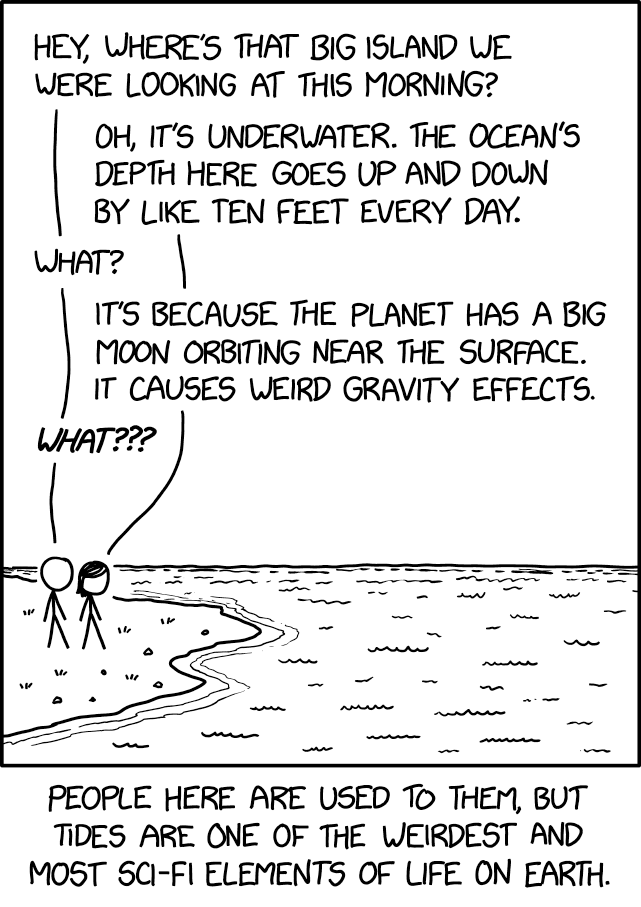

Alt text: They’re up there with coral islands, lightning, and caterpillars turning into butterflies.
You must log in or register to comment.
Our planet is scifi as hell. We’ve got natural magnetic shielding to protect our UV-blocking ozone layer from solar winds. This planet is so damn cozy<3
This planet is so damn cozy<3
Oh! Oh! Let’s wreck it by polluting the hell out of it :3
:(
I wish we wouldn’t
but yummy pollutants! :3
Poison the air and recieve pieces of colored paper in exchange. It’s a good trade
Don’t forget only a few lucky and dumb sociopaths hoards all the colored papers while the rest gets shiny round metals.
You know it’s too expensive to fix for the people and companies with more wealth than 99.99999% of us, and with the decision maker(s) not valuing any future beyond their expected lifespan, and I don’t think any of them think the previous generation will be the last generation to die
Don’t worry.
They have plans underway to terrorise us with intentionally worsening it under the pretence of trying to mend it, to induce us into obedience under their tyranny, so we don’t rise up against what they’re doing.
Sleep tight.
For now

But is that unusual? That’s just pretty normal, no?
Any planet with a liquid core is bound to have one.
Maybe‽
We don’t have much of a basis for comparison outside of our solar system just yet, but we should have better data soon.
And it being “normal” would just make it more science fictiony. =D
We probably won’t have better data soon. Actually resolving planets directly is incredibly far out of reach. Measuring their core is implausible.
The core, no, but detecting the effects of a magnetic field are not out of the question.
I think it’s more wild that not only are big moons rare, ours is literally the same size as the sun from our point of view.
It also makes almost exactly 13 laps for every lap the earth makes.
Which is why a 13 month calendar all having 28 days would have made more sense
It makes 12 months because the lap the Earth makes is deducted from the 13 the moon makes, so effectively it makes 12 cycles around the Earth.
You don’t know what you’re talking about
13x28=364. The moon makes 14 sidereal orbits, not 13. The reason the year is split into 12 months is a combination of Roman dipshittery and the fact that 12 is divisible by 2, 3, 4, and 6. The number of factors of 12 made 12 and 60 way easier to work with for societies that hadn’t invented the decimal point yet.
Then please explain how the Hebrew calendar, and all other lunisolar calendars (calendars which follow both the solar year and the lunar cycle) have 12 months most years? https://en.wikipedia.org/wiki/Lunisolar_calendar
“The majority of years have twelve months but every second or third year is an embolismic year, which adds a thirteenth intercalary, embolismic, or leap month.”
Not who you asked, but after looking into it it’s because the moon takes about 29.5 days to complete a full cycle of phases (one synodic month), giving it time to do so roughly 12 times per year.
I can’t quite wrap my head around it, but I think the explanation for why sidereal and synodic months differ lines up with your initial explanation. Because we’re also moving, the moon has to move further to achieve the visual change of moon phases.
Thanks. I think the user who replied to me is the one with no idea that they’re talking about. No way of measuring it comes close to 14.
Can you provide a source for 14 orbits? Everything in my search results says 13 and some change.
Wikipedia says one sidereal month is 27.321661 days and a sidereal year is 365.256 days.
365.256/27.321661 ≈ 13.37
a sidereal year is 365.256 days.
No. A sidereal year is 366.24 days.
And 11 days isn’t “and some change”
The figures in my post are ephemeris days since that’s the way Wikipedia lists them.
https://en.wikipedia.org/wiki/Sidereal_year
https://en.wikipedia.org/wiki/Lunar_month#Sidereal_month
“And some change” is a phrase to refer to a number following a decimal point, meaning the sources I find claim there are thirteen point something sidereal months per year, at a figure too low to round to 14. Here are some example sources:
https://en.wikipedia.org/wiki/Orbit_of_the_Moon#Lunar_periods
http://scienceline.ucsb.edu/getkey.php?key=1126
I still can’t find a source which says the moon makes 14 sidereal orbits per year, using any definition of year.
12 is an easier number to work with because of how many factors it has
hmm, how about 12 months each with 30 days, plus 5 days every year that’s not part of any month?
5 days every year that’s not part of any month
Those are called intercalary months. They had them in the ancient egyptian calendar (5 every year, 6 in leap years) and were usually used for rest and religious ceremonies.
I’m pretty sure they’re being cheeky and we’re referencing exactly this ;)
plus 5 days every year that’s not part of any month?
Just add a leap month every six years
You’d have 12 30-day months most years, and an extra in the sixth! While we’re at it, we can redefine a week to be six days, so there’s a perfectly rounded number of weeks per month/year! Days, hours, minutes and seconds are already fine, but maybe we should also replace units shorter than a second with something more dozenal/hexal(?), too…
While a novel idea, a leap month would throw the concept seasons and therefore agriculture off significantly. Relatively predictable seasons and being able to track our place in it with calendars was a great help to agrarian communities, helping them know when to plant and harvest most effectively.
deleted by creator
Every 7 or 6 years for a leap week 12 month calendar, it would be four times longer for a leap month, and the formula is a bit too complex for people to do in their heads, but we all refer to computer calendars anyway
A 364 day calendar with 13 even months, or 12 months alternating between 35 and 28 days or whatever would also let you use the same calendar every year (as opposed to my tea towel that has a calendar that is only useful in leap years that start on a Tuesday — the last was 2008 when it was bought, next is 2036)
Though it would be too expensive to change the calendar, and a 364 + leap weeks calendar doesn’t track the seasons as well as 365 + leap day calendar, I really like the symmetry 454 calendar
plus 5 days every year that’s not part of any month?
Get this Roman bullshit outta here
13*28=364 so even 13 months and 28 days doesn’t work.
If we had 28 days in a month then the week needs to be something other than 7 days. Three out of four times February / March fucks me over by having the same weekday/ day of the month.
There is a calendar that uses 28, 35, 28 day months each quarter for 364 days, with the last quarter having an extra week (or having an intercalary week so they can pretend quarters will be all equal) in leap years
Only for pre-decimal society. Nowadays it’s not a problem
Landlords would love it, at least. I personally would hate it, being a renter.
Haha great point. I never thought of that
Don’t worry, they ain’t ever gonna replace the Gregorian calendar.
It’s a shame, though. That Jeromian 13 month one sounds like a better fit, whether or not you’re in Vancouver!
Your rent right now can be thought of as a large payment split into 12 equal pieces (even though months aren’t actually equal) and your rent payment is just 1/12 of that. If there were 13 months it would just be split into 1/13 so each months payments would be slightly smaller to be the same total
If we transitioned it would take years and for at least some amount of time of overlap they would show both prices so it would be much harder for them to just jack up the price like they would prefer to do
Landlords would love it, at least.
And I thought you ment because the pubs would be full that week :-(
13 is a unlucky superstition number.
Only in Western cultures. In East Asia, it’s 4.
They have a different calendar too, no?
Nope, theirs is also the same. Just another same than ours.
In China, it’s 8 due to the number sounding like the Mandarin word for death
In my understanding, 4 sounds like the word for death and 8 sounds like the word for wealth, so 8 is considered lucky.
But I don’t speak any version of Chinese, and could very well be wrong.
Didn’t some cultures do that?
And from what I have heard on science podcasts, the moon is, and has been, and still will be, moving away from the earth. Making the perfect solar eclipse only for a segment of the earth’s history.
It honestly makes me feel lucky being born when I was.
We also get to see the after effects of the big bang which won’t be detectable for the majority of the lifetime of our universe.
The big bang part is interesting, because, if humans become successful and manage to somehow make some sort of long-lasting archive that would survive on universal scales, we would be the ancients with old revelations to a potential future species. Able to impart knowledge that would have been undetectable for them, and an ancient map of the stars containing visions of countless other galaxies, and a peek into the very beginnings
Though, realistically, it’s likely that a hypothetical hyper-advanced technological species would have their ways of prodding the true nature of our universe, despite the greater challenges
Child you elaborate on the second point? Why is it only visible in a short period?
Cause the expansion of the universe. Eventually we won’t be able to see beyond our own galaxy.
Aha I see
A bit late, but the moon does not make “almost exactly 13 laps”. Info from https://en.wikipedia.org/wiki/Lunar_month
If going by phases of the moon (synodic month), it makes 12.37 laps in a year. Not close to a round number.
If going by position in the sky relative to the stars (sidereal month), it makes 13.37 laps - one more than the former measure, because of Earth’s year cancelling out one month.
There are also other ways to measure it, but none of them get anywhere close to an integer number per year.
deleted by creator
Gross
I don’t recall what I was reading, but I once read about a lot of things lined up perfectly for evolution on Earth.
- In Sol’s habitable zone
- Has a moon
- Rotates on tilted axis
- Stable rotation and orbit
- Has magnetic field
- Has Ozone Layer
- Big planet (Jupiter) close enough to catch random asteroids, but not close enough to harm Earth
It’s bonkers that it all worked out that way so that I could be here, right now, reading your post and responding. It really boggles the mind and I don’t want to waste my time.
Welp, guess I’m gonna go look up random curse words in the dictionary. ಠᴗಠ
This is rather as if you imagine a puddle waking up one morning and thinking, ‘This is an interesting world I find myself in — an interesting hole I find myself in — fits me rather neatly, doesn’t it? In fact it fits me staggeringly well, must have been made to have me in it!’ -Douglas Adams
Lines up perfectly … for life as we know it. See also: The Anthropic Principle
But in the vastness of space, it was practically guaranteed to happen somewhere. There are a set of criteria that allow for the evolution of life (as we know it) and it was going to happen somewhere, the fact that it happened here is no more awesome than it happening 3 galaxies over.
I know the feeling you are describing and the words to describe what i am trying to say are hard for me to grasp.
Its like in a film where the hero survives seemingly impossible odds and people watching say “no way, thats impossible” and can’t enjoy the film because its too unbelievable. I say no! This is a story about the one almost impossible time all these things happened. Thats the point. Yes its hard to believe, but thats what makes it awesome.
So the earth being here and humanity and all other animals evolving here is just the time in the impossibly vast universe that the “stars aligned” and the fact that we are experiencing it is just expected.
But in the vastness of space, it was practically guaranteed to happen somewhere.
Do we know this for sure?
When we thoroughly shuffle a deck of 52 cards, we’re almost certainly creating a new deck order that has never been seen before and will likely never be seen again in a random shuffle.
The number 52! is 8 x 10^67, so large that we can make the equivalent of a billion (1 x 10^9 ) shuffles per second per person on earth (8 x 10^9 ), so that in any given millennium (3.15 x 10^10 seconds) we’ve covered a percentage so small it’s got 36 leading zeros after the decimal point for the percentage, or 38 leading zeroes for the ratio itself.
My impression is that factorial expansion for probabilities moves up much faster than the vastness of space itself, but I don’t know how to calculate the probabilities of each of these priors.
Some people are bad at shuffling though. It’s not like they actually randomize the deck perfectly each time.
So bad that bridge players see a perfect deal like once a decade. It often makes the news.
A deck of cards is actually random, whereas star, planet and solar system formation is constrained by a load of physical laws, mainly gravity. We know little about solar system formation, but sufficient to say it’s not a card deck shuffle, which is pretty much customised to be as random and unpredictable as possible. It’s counterintuitive in a way, that something as mundane as a deck of cards could be mathematically so extreme, while celestial bodies tend towards equilibrium and similar configurations, but it’s true.
By contrast, one of the most important scientific rationales of the enlightenment is the Copernican Principle, which states that humans do not have a privileged position in the universe: where we are is pretty typical. Or, at a large scale, the properties of the universe are the same for all observers.
But, in answer to your first question, no. We absolutely do not know this for sure. It’s just pretty solid reasoning.We know little about solar system formation, but sufficient to say it’s not a card deck shuffle,
Well it’s different in several factors competing in different directions, and it’s not clear to me what the overall aggregate direction is.
The fundamental force of gravity is going to drive a lot of disparate starting points to collapse into similar results.
But in the end, we’re still talking about the probabilistic chances that certain lumpiness in the distribution of mass from supernovas or whatever forms the matter of solar systems, and how each solar system’s spinning disk coalesces into planets with their own elemental composition and orbits and rotations and moons and internal rotation and energy that might make for magnetic fields, plate tectonics, etc.
If the probabilities of those may still have some independence from one another, then even if there are lots of stars like ours and maybe even lots of planets that are earth sized, and lots of planets with the oxygen to make water or carbon to make organic chemistry or the iron to make a magnetic field, we might still recognize that the correlations between these not-fully-independent variables still require stacking probabilities on probabilities at a factorial rate.
While the number of opportunities for those conditions to hit might go up at an exponential rate, if the probabilities are small enough and there are enough necessary factors for life stacking on each other, it’s entirely possible that the exponential expansion of more solar systems than we could fathom is still too small to make for an appreciable probability of the conditions of life.
I don’t know what the probabilities actually are. But I can see how the math of the combinatorics can totally dwarf the math of the vastness of the universe, such that the overall probability remains infinitesimal.
The aggregate direction is always towards highest entropy, which means lowest energy state, stability etc. Planets tend to self organise into harmonic orbits with simple whole number ratios, because that’s the lowest energy state. But the result is that we have a nice, stable solar system where planets have relatively circular orbits with nice spacing. Despite the initial chaos of the formation, it’s very likely that all solar systems collapse into this kind of high entropy, regular stability, and what little observations we can make of other systems have confirmed it.
The point is that it’s not at all random, there are irresistible forces at play which narrow the space of what’s possible into a very small box, cosmologically speaking. Matter organises itself into spheres, then into orbits etc. We don’t see disc shaped planets for example because they’re physically impossible to make using natural processes. And we don’t see planetary collisions because they can only happen at the start, in the chaos of system formation. Then it all settles down into a stable, predictable, harmonically resonating system, as the laws of thermodynamics predict.I’m not disagreeing with you on any of the physics of solar system formation, just disagreeing with your interpretation it means that habitable planets are high probability.
When clouds of dust and gas settle into spherical planets, what makes them rocky? What makes them have magnetic fields, atmospheres, water? What makes it so that the planet in the habitable zone hits those conditions.
The tendency of certain things to develop isn’t a lockstep correlation of 1 between these factors.
We can believe that stars are common. And so are planets. But what combination of factors is required for life, and does that combination start leveraging the math of combinatorics in a way that even billions of planets in each of trillions of galaxies wouldn’t be enough to make it likely that there are other planets that can give rise to life as we know it.
My point isn’t actually about cosmological physics. It’s a point I’m making about the math about probabilities being counterintuitive, in a way that “the vastness of the universe” doesn’t actually mean that life is inevitable. It might still be, but it doesn’t necessarily follow.
Well I didn’t specifically say habitable planets are high probability. But it just so happens that they are. Firstly consider the Copernican Principle. If we live on a habitable planet then it’s logical to make the assumption that habitable planets are common. There are strong counterpoints to this, but it’s all very hypothetical anyway so it’s better to just point to the empirical evidence: astronomers estimate that [one in five stars has an earth sized planet in the Goldilocks zone](One in Five Stars Has Earth-sized Planet in Habitable Zone – W. M. Keck Observatory https://share.google/J40L3PlVnAvee7C7B). In terms of the why, it’s a much more difficult question to answer, but the stages of planetary formation that are proposed include processes whereby heavier elements coagulate together, earlier, and those that end up massive enough then attract lighter elements and become gas giants. Rocky planets formed close to the sun because it was hotter there and water/ice couldn’t form and contaminate the denser elements, although it doesn’t seem to happen that way in other artist systems.
Everywhere we look we see rocky planets and we see water. It’s not unlikely that rocky planets therefore would have liquid water fairly often
Look up Douglas Adams’ puddle analogy?
“If you imagine a puddle waking up one morning and thinking, 'This is an interesting world I find myself in — an interesting hole I find myself in — fits me rather neatly, doesn’t it? In fact it fits me staggeringly well, must have been made to have me in it!"
How does having a moon and the tilted axis contribute to evolution?
IIRC; Tilted axis gives us the seasons by doing so causing weather and water streams. Also lightning. Having a moon causing the tides is what’s believed to be the reason for the chemicals in the dirt and rocks mixing well to prepare the amino acids or something similar.
Thank you for the explanation.
Having a moon causing the tides
Our moon is not the only reason for the tides existing, our Sun kinda also have gravity, so it causes tides too.
The moon, due to it’s unusual size and proximity for a moon, has a much greater effect on the tides than the sun. That’s why the tides are more closely linked to the moon’s orbit around the earth, not the Earth’s around the sun.
They are linked to both though. That is why you get even higher tides at some times of the year. The moon has a larger effect but they can combine.
There are a few reasons but I kind of think it boils down to biodiversity. Seasonal changes, tides, light exposure, and varying temperatures would affect the balance of diverse life.
For example, Earth didn’t always have oxygen. 2.4 billion years ago there was a bunch of microbial photosynthesis happening. Seasons and the tides affect ocean currents which moved nutrients around, allowing the bacteria to thrive and grow.
Ozone’s formula is O3, so the Ozone layer wouldn’t have formed either.
There are also other issues like how the seasons affect biological migration or how the moon slows the Earth’s rotation to about 24 hours/day.
Seasons add variability, which helps select life that is adaptable and less likely to be wiped out.
Moon keeps the ocean moving, circulating the oxygen and nutrients.
Thank you for the explanation.
‘lined up perfectly’ is a stretch, considering it’s safe to assume these ‘perfect’ conditions have appeared more than quadrillions of times within the universe
…and of course we’re in the darkest parts of that universe, so we will never be able to experience other similar worlds. Damn.
Oh for sure. The universe is too big for it to not have happened elsewhere. I’m not saying it’s unique, just rare.
For me, it was the fact that the Earth is tilted at just the right angle that sort of blew my mind. Too much one way or another, we wouldn’t have seasons or day/night cycles.
From under, other planets have been identified with the potential for life, but don’t have the tilt or the moon.
The sole fact that we’re here means that we don’t even have to think about those, but yeah.
Ah btw, this is the gravitational form (geoid) of earth:

The meters is the height difference of orbit.
Damn, now I get why cartographers and the like always try to make it prettier in post!
Never thought I’d be body shaming the Earth, but here we are 🤷
That is pretty severely exaggerated though to emphasize the form.
Lol, but the diff is actually x10000 or something, to make it more visible
That’s just mean! 😉
If the Earth was scaled down to the size of a billiard ball, it would be the smoothest billiard ball in existence.
Except for Howie Mandel’s head, of course.
I’ll take your word for it, because it would be awfully hard to compare it to other billiard balls after we’d asphyxiated from the atmosphere dissipating into space.
Its the water that makes the world
go aroundThis is not to scale. If it was you would see a perfect fucking sphere cause it’s that damn small of an image.
Winter is kinda wild too. The fact that the planet is tilted just enough to make it cold part of the year, but not so cold that it kills everything, and many plants and animals have integrated this into their life cycles.
If only we could cap our carbon emissions enough to keep it that way. But at least the top one percent are making money
What’s money
Edit please don’t answer I have a degree in economics I am and was being a dipshit asking a rhetorical question about abstractions
What’s money
The root of all evil.
What’s holding us back.
What’s keeping [the psychological short-sighted greed-trap and duress in place to keep] the emancipatory technologies suppressed.
I have a degree in economics I am and was being a dipshit
Yes.
please don’t answer
No.
asking a rhetorical question
I’ll have my fun anyway.
;D
Thank you for answering in the spirit of my question and not wasting my time (time enjoyed is never wasted)
Evolutionary niche fits the conditions.
If it were tilted differently (within reason), then different life would have evolved.
Life exists in the places here that only get one day a year. Once it gets started it fits itself into every niche. The only question is how hard is it to get started.
By far the coolest and most unique aspect of the Earth-Lunar system is solar eclipses. The size and orbital distance is just right to allow for the spectacle we get today.
This is even more true when you consider that the Moon’s average orbital radius is increasing by 3" (76mm) each year. In a million years, the Moon will be too far away to fully cover the Sun. A few million years ago it was close enough to fully cover the corona
Honestly, whenever I think about this, I get my tinfoil hat moment. Life being created by statistical probability and chance, well ok. Life being created and people with conscientiousness rising up at exactly the time this one planet has this perfect orbital distance - give me that tinfoil.
That’s just our bias talking. There’s certainly many other wonderful events we missed by a couple million years. We just think the moon size is special because of this coincidence.
Like the dinosaurs probably being around while the earth still had rings, right?
I didn’t know that fact, but yeah
Earth’s orbital distance has pretty much always been “perfect” though. It hasn’t really changed much since it’s formation 4-5 billion years ago.
Unless you mistyped and you’re talking about the moon’s orbital distance? In which case, it’s actually kind of the opposite of what you’re claiming. It’s estimated that life first popped up pretty close to when the planet and moon finished forming, at which point the moon’s orbital distance would have made it appear larger than the sun and probably fully obscure the sun + it’s corona during an eclipse.
I did mean the distance between earth and moon, thanks for correcting!
It’s the ratio of orbital distances being perfect for total solar eclipses, so it’s technically both orbital radii
A still more glorious dawn awaits
Not a sunrise, but a galaxy rise
A morning filled with 400 billion suns
I get similar feelings about earth when I can see the moon during the daytime. Something about seeing it with clear craters against the blue sky makes it feel much more like we’re just floating in space with a cratered barren partner.
And the sci-fi cliche is to have enormous moons filling the sky, but realistically, ours is comically large. Even planets in our solar system mostly see moons the way we see those planets. You get a dot.
Only Pluto and Charon got us beat.
At least in terms of lower mass difference between the two bodies, and the distance the barycenter is moved from the center of the larger body.
[Edit: … maybe Eris and Dysnomia come close too. … and worth another mention that Jupiter tugs the barycenter further from Sol than Luna does from Earth. But all that’s a different beast from visual size.]
I like to read science history books, the process of discovery and methods people come up with in search of answers is fun. Anyway, I read a whole book about tides, and one of the reasons people thought the tides rolled in and out was because somewhere in the ocean, a massive creature was slowly breathing in and out enormous volumes of water. These same people still went out on boats.
And seahorses! Dont forget them!
Hearts in their head. Males carry the babies.
They’re insane!
Can’t forget magnets. How do they work?
Magitech.
Only if Knowledge doesn’t get her way. But considering Travis…
Like other elements, just a bit farther reach with their fields. Fun fact, nothing is solid. When you try and touch something, it’s actually just forces against forces. Atoms are primarily made of nothing.
I feel the (strong) force.
They have small pieces of gravity in them.
I wonder if life would exist on our planet if there were not tides.
The Sun also creates tides, just not as strong as lunar tides. So we would still have tides, even if we had no Moon.
The Sun also creates tides
The second worst British tabloid? I highly doubt it.
The ol’ Lemmy-roo!
You should check out king tides https://en.wikipedia.org/wiki/King_tide
Exoplanets could have tides too though…
It’s unlikely that there are many exo planets with a moon as big as the Moon. Much more likely to have small ones like Mars. Mercury, Venus and Mars are all great examples of bad shit that can happen to planets: Tidally locked + too close to the sun, rolled over on the side, and finally Mars too small to maintain a molten core and magnetic field. The Moon helps avoid the Venus situation and maybe the Mars problem.
Our moon has a name, it’s Luna
Do you think “big enough moon” is going to be similarly rare to “liquid water”? We’re getting better and better at finding planets. Not sure how we’d find their moons though.
It does seem like figuring out their moon situation is still pretty speculative…
Well it’s not near the surface but rather far away in comparison. But also really big a moon.
So basically … like Miller’s Planet?
So… is the moon a black hole?
If the moon was near the surface of the earth, I think we would have a lot more problems, like the tidal forces would tear the crust apart
The Moon is so far from the surface of Earth you can comfortably fit every single planet in the solar system between Earth and the Moon.
This would lead to a cataclysm and people would generally disapprove of you doing this, but the point is there’s space in space.
On a cosmic scale it already is pretty near to the Earth’s surface.
What blows my mind even more, is, contrast to the fact that these tides are from Luna’s pull on Earth, which does not move the barycenter outside earth, the effect of Jupiter on Sol, does pull the barycenter outside Sol! Get your head around that, eh!?!!
The Sol-Jupiter system would have a bary center just 7% outside the surface of Sol. The effect of all the Gas Giants together can either center the syster in Sol’s core or move the barycenter 120% outside Sol.
The really weird thing is that the part of stars outside the core is more like an atmosphere. If the star gets hotter, the parts outside the core can expand. This is happening slowly as Sol’s core fills up with Helium and becomes denser, which fuses Hydrogen faster. So despite weighing less, the Sol-Jupiter barycenter will be engulfed within Sol’s envelope. Once Sol stops fusing Hydrogen in it’s core, the core will shrink and heat up, fusing Hydrogen in a shell around the core, which will cause the envelope to grow and engulf Venus and possibly Earth directly, and definitely contain the full system’s barycenter. After that it will release a bunch of mass in a planetary nebula, which will cause it to shrink a lot, and the remaining planets will probably orbit much farther out, which would throw the barycenter waaaayyyyyy outside of the white dwarf left over.