
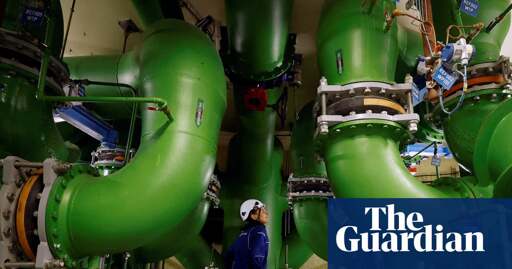
As heatwaves intensify across Europe, most cities are reaching for a familiar fix of more air conditioning. But in 1990s Paris, planning began for a different kind of solution: one of the world’s largest district cooling networks.
The system has 120kms (75-miles) of underground pipes distributing chilled water to museums, offices, hospitals, schools and other public buildings including the Louvre, the Grand Palais, and some luxury hotels and office districts. Instead of thousands of individual air-conditioning units, cooling is produced centrally and shared across the city like a utility.
The system circulates cold water through a network of pipes: cold river water from the Seine is pumped through one pipe, which runs right next to a secondary pipe carrying warm water from the city’s buildings. A thin metal wall separates them and a heat exchanger allows the heat from the warm city water to enter the cold Seine water without the fluids ever touching. It is similar to holding a cup of hot tea in a bowl of cold water – the liquids don’t touch, but the tea cools down
It will be a miracle solution until the elevated water temperatures start affecting the ecosystem downstream and potentially the health of the river as a whole, if not the effectiveness of the system itself. Then people will realize that actually perhaps it wasn’t so miraculous after all, and like all engineering choices, is a compromise between what we’re getting from it and what we’re giving up. We could even point at the new algae problem in the reflecting pool as an example of such unintended consequences from heating the water above traditional norms. For some of the same reasons you shouldn’t dump raw sewage into the river, it’s not an infinite garbage disposal, it can’t just endlessly absorb your waste whether it’s domestic, biological or heat or anything else. You’re not getting rid of it, you’re just making it someone else’s, somewhere else’s problem, potentially at some other time. But maybe it’s a reasonable solution for right now, it might be better than the alternatives, maybe the tradeoffs are pretty minor or even legitimately ignorable when weighed against the benefits. But as long as we cling to the insane idea of endless, infinite economic growth, they’re only ignorable until it that growth makes it inevitable that someday they’re not, and calling it miraculous feels a lot like pretending there aren’t any downsides, and I don’t really like that in principle.
Air conditioning pumps exchanges heat with the air. Fluid heat pumps exchange it with the water.
The same amount of heat is being displaced regardless; the question is how much new heat is being created by the mechanisms involved (and their related power generation).
Toronto has a similar system(s) exchanging heat with Lake Ontario (BIG thermal mass holder)
agree that using ‘miracle’ as a description of this engineered remedy is inappropriate
I don’t think you grasp the sheer volume of water flowing through the Seine. Even after the planned expansion that triples the size of the system, under drought conditions it’ll only raise the temperature of the river by about 1.5°C, and most of the time it’ll be much less than that. Sure, the river isn’t big enough for the system to cover every building in Paris, but this expansion is sustainable.
Some kind of ground-based heat exchange system would probably be ideal. That way in the summer you can dump heat deep into the ground, and in the winter you can run the system in reverse to reclaim what remains of it for heating.
I don’t think you grasp the sheer scale of humanity’s ongoing and relentless efforts to exceed even the most optimistic projections of any possibly sustainable boundaries, without any regard for anything beyond their completely myopic perception of their immediate needs in the present moment, but I do appreciate the context you’re providing.
I think I do.
France is in the EU and in the EU we have this thing called rule of law. The law in this case places limits on how much effect industry can have on the temperature of natural bodies of water. I believe in this case the limit is 1.5°C, so the system will basically by definition not exceed that.
I have no personal experience with that. It must be really nice.
I don’t think you grasp the sheer volume of water flowing through the Seine.
Not just the volume or the mass, either. The specific heat of water is so high that a kg of water can absorb 4.184 kJ for each degree Celsius. Air is about 1 kJ kg/°C, but also is about 1/900 the density at normal sea level temperature and pressure. So assuming some humidity, we’re talking 3500 liters of air being cooled by 1 liter of water, for each degree of temperature change of each.
The upside to systems like this, though, is that once the infrastructure are in place, cold water could be supplied instead by a chiller plant instead of the river.
It is air conditioning. It just happens to be dumping the energy into the river instead of the air.
New systems like this in the USA are illegal despite how energy efficient it is.
I tried water based floor cooling. Until the mold grew under the couch.
Cool to see it in a river, it’s been used in Toronto for some time. I got to tour the exchangers at John St. a lifetime ago 😅
https://en.wikipedia.org/wiki/Deep_Lake_Water_Cooling_System