The name Arctic has nothing to do with the presence of bears, it got its name from either of the two star constellations Ursa Major or Ursa Minor (Edit: meaning big and small bear), where ursa is arctos in Greek, which are both present in the northern hemisphere and tge latter even contains the celestial north pole.
The word Arctic comes from the Greek word ἀρκτικός arktikos “near the Bear, northern”[4] and from the word ἄρκτος arktos meaning “bear,” named for either the constellation known as Ursa Major, the “Great Bear”, which is prominent in the northern portion of the celestial sphere,[5][6] or the constellation Ursa Minor, the “Little Bear”, which contains the celestial north pole (currently very near Polaris, the current north Pole Star, or North Star).[7]
But I suppose your point is that it is a degree removed from bears, that it is based on the constellations that are based on bears, rather than direct… But “nothing” to do with bears isn’t correct …
I think the point is that there are no kangaroo constellations in the northern hemisphere. There would be no bear constellations, either, except for the presence of bears.
BTW, “bear” means “the brown one”, which is more or less “the animal that must not be named”. This is true in a bunch of languages (Czech has “the honey eater”).
This is sometimes called the Indo-European Bear Taboo, because it’s observed in many IE languages, mostly northern and central ones.
In some areas without bears it looks like mountain lions get the same treatment. So it may stem from a common IE tradition of euphemizing the largest predator and that tradition changed as IE groups moved into new areas.
But it may just be a human tendency to avoid speaking the name of dangerous or hateful things - many use euphemisms instead of saying trump’s name.
From a similar thread on the other website hypothesizing what the Modern English word would be if it survived:
After the later metathesis to *h₂ŕ̥ḱtos, it could have become Proto-Germanic *urhtaz, which might have taken any number of forms in Old English, *urht, *orht, *roht. Probably at the extreme it could have become English *rought, pronounced like ‘wrought’ or ‘rout’.


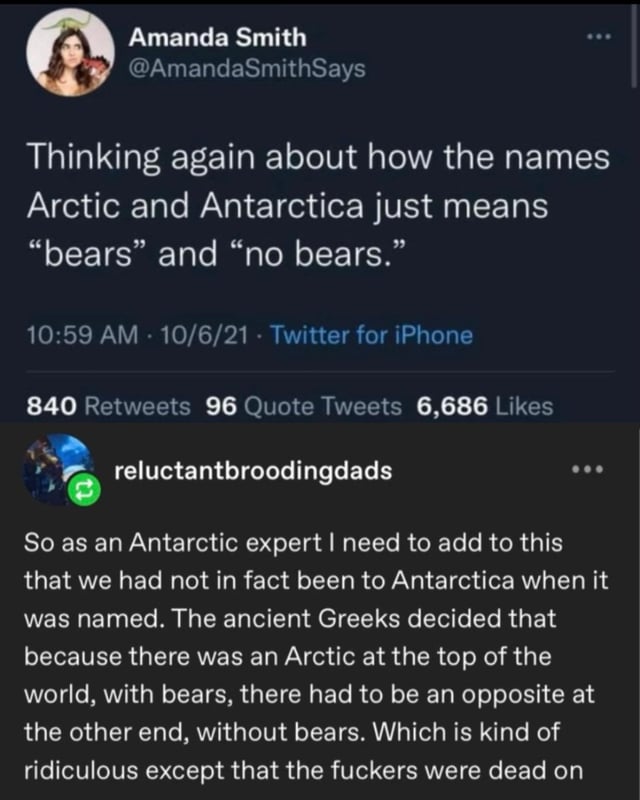
The name Arctic has nothing to do with the presence of bears, it got its name from either of the two star constellations Ursa Major or Ursa Minor (Edit: meaning big and small bear), where ursa is arctos in Greek, which are both present in the northern hemisphere and tge latter even contains the celestial north pole.
https://en.wikipedia.org/wiki/Arctic
Also, ‘ant-’ just means “opposite”. It can negate a statement, but it can also express opposition or relative position.
In this case, ‘Antarctic’ just means “on the opposite end of the planet from the Arctic.”
I think you are trying to say “well duh, of course they were dead on. The stars literally aligned and told them that.”
But is the presence if Ursa not the presence of bears?
Why do you think Ursa Major was in the northern sky? To the ancient Greeks, bears were things that lived in the north.
Way to ruin it party pooper!
And those are all “bear”…
But I suppose your point is that it is a degree removed from bears, that it is based on the constellations that are based on bears, rather than direct… But “nothing” to do with bears isn’t correct …
Nothing to do with the presence of bears. The stellar constructions aren’t actual bears.
I think the point is that there are no kangaroo constellations in the northern hemisphere. There would be no bear constellations, either, except for the presence of bears.
That’s a good point.
NotWithThatAttitude!
If those aren’t real bears, then whose blood is it that turns the leaves red in the fall?
Jesus?
That’s my name, don’t wear it out
Source??
Nah, I don’t think that’s right. Those constellations are 100% actual bears
we are all just cosmic dust, including bears
I’ve seen Hercules
Could have sworn it wasn’t phrased that way when I first read the comment…
No, I just added the translation “big and small bear” which I forgot before.
BTW, “bear” means “the brown one”, which is more or less “the animal that must not be named”. This is true in a bunch of languages (Czech has “the honey eater”).
It might be the oldest known euphemism.
This is sometimes called the Indo-European Bear Taboo, because it’s observed in many IE languages, mostly northern and central ones.
In some areas without bears it looks like mountain lions get the same treatment. So it may stem from a common IE tradition of euphemizing the largest predator and that tradition changed as IE groups moved into new areas.
But it may just be a human tendency to avoid speaking the name of dangerous or hateful things - many use euphemisms instead of saying trump’s name.
Also happened with “beaver” in at least Germanic, Celtic, and Balto-Slavic, so not just apex predators.
That certainly explains all of the “pet names” I’ve given myself over the years.
Can you supply a link re the mountain lions? Not bc I disagree, just want to read more
I can’t remember where i heard it, i think it was mentioned maybe in a video by stefan milo or crecganford?
All i could find in a few minutes of googling is this paper on polish etymologies of bear, lynx and wolf as possibly taboo zoonyms.
one day I will say the true name of the bear and summon The Brownest One
You’d better eat all your honey beforehand or you’ll lose it.
Mmm. Honey filled snack.
You assume the honey is for me and not an offering
That’s only for the Slavic “bear” euphemism, medved “honey-eater”
Is there a Russian tennis player with this name?
From a similar thread on the other website hypothesizing what the Modern English word would be if it survived:
Good luck with your summoning!
If i remember correctly bear isnt even the actual name but another nickname, the real name is long forgotten and replaced by winnie the pooh
And I imagine Antarctic has some relation to being the antipodean arctic
deleted by creator