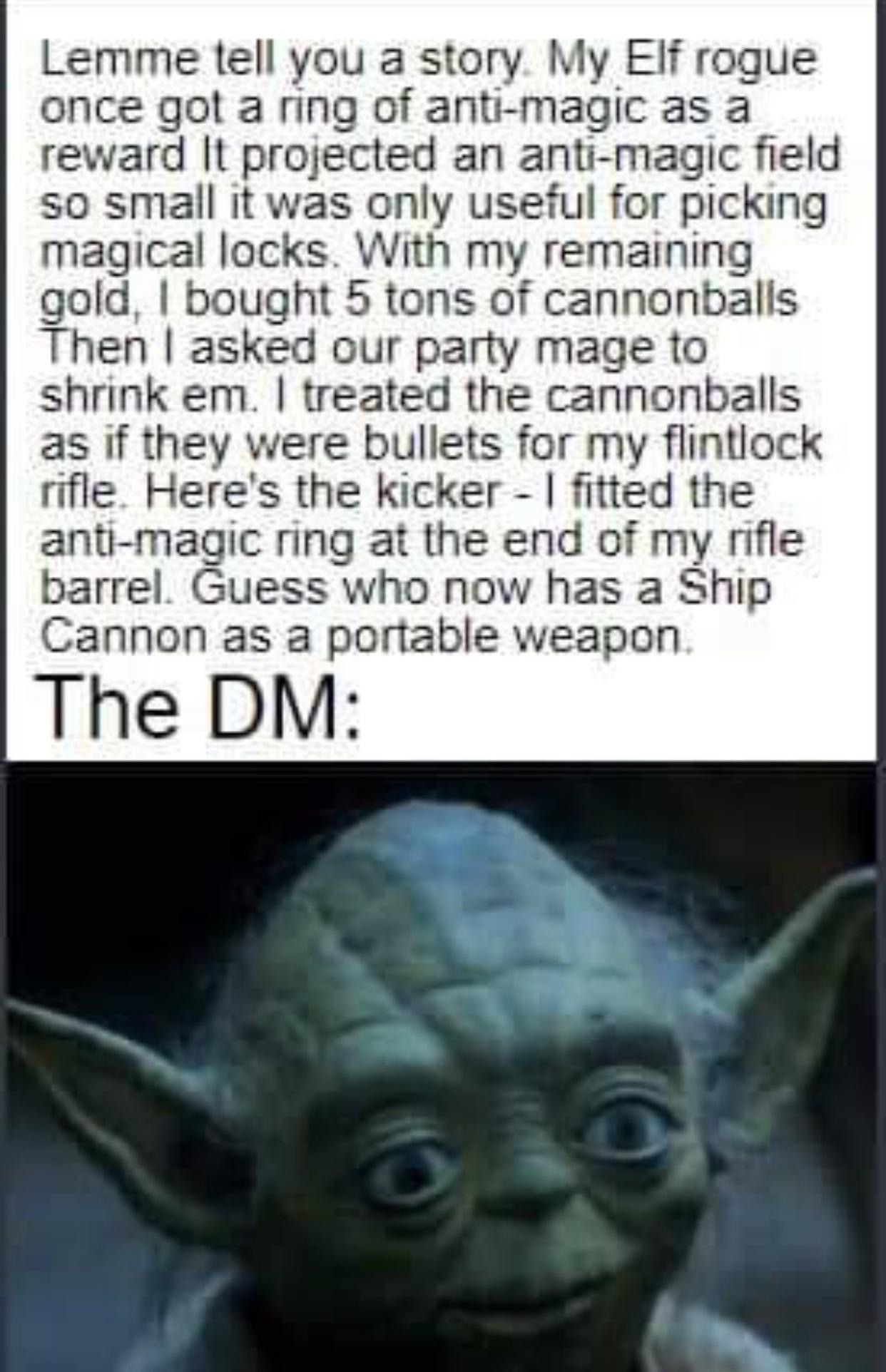
I think the party missed another interesting (albeit elaborate) use.
Find a large pointy rock. Shrink it down to the size of a small arrow head. Attach it to an arrow shaft such that the head will slide off the end of the shaft without too much effort (staying embedded in the target). Have the rogue launch it at the big bad, then have the barbarian or monk punch the arrow wound while wearing the ring.
This is creative. I like this.
if the ring permanently ends magical effects that enter its area of effect, that’s unusual and probably has a bunch of unexpected uses.
It it merely suppresses magical effects in its area, I guess the projectiles would briefly return to full size when in the anti-magic field, and return to small size afterwards? Doesn’t seem very effective unless you like point blank someone.
Because I hate fun, I assume that the people in a fantasy world aren’t all fools so if there’s an application of magic that seems obvious but isn’t already happening in the setting, there’s a good reason for that.
There’s also the rule of “if you can do it, so can NPCs”. Even if your character has thought of something no one in the universe has thought of before, word will get around.
I have it as: “cool idea, i’ll let you get away with it once. Start abusing it and all the NPCs start using it.” works pretty good.
I love how everyone is discussing the physics of a cannonball gun DIY setup in a game where magic can instantly teleport people or turn a person into a huge dragon.
I’m not complaining, I just find it amusing.
I imagine that the momentum would be conserved. So if the rifle normally shot a 30 gram ball at 300 meters per second, it would shoot a 5 kilogram ball at around 23 meters per second.
- The larger size and lower speed of the cannon ball would likely reduce the range.
- The larger size of the projectile would spread out the impact causing reduced damage.
- The ballistics would be significantly different making it far harder to hit with.
This is how I would do it in my game:
- Reduce the damage from 1d12 to 1d10
- Change piercing type to bludgeoning
- Reduce range from 40/120 to something like 20/60
- Add knockback of 5 ft to medium targets or 10 for small
The really neat thing would be shooting non standard rounds that wouldn’t be possible from a musket like incendiary or smoke rounds.
This exact mechanic is present in the Mistborn book series. I don’t want to give spoilers because I recommend the books so highly, but I love the hard science nature of the way the magic system interacts with physics.
I think damage reduction would be even more than that. The damage a projectile does to a target is directly related to its kinetic energy which is calculated as e = ½mv². So when you increase mass but reduce velocity you also reduce the damage by the square of the difference in velocity (I think). As long as the damage just relies on the physics of the projectile and not magic, that is.
I was assuming that the total energy would be maintained (In this case 1350 joules) and thus the damage should be the same if weren’t spread out. It has been 20+ years since I has to do any of that math so I could be wrong about any of that. And since the only paper that was handy happened to be an envelope I guess it was technically back of the envelope math. :)
is a “30 gram ball” some kind of archeaic unit? 30/5000 = 1/166 != 23/300 = 1/13.
but anyway, I feel this ruling would open an even better exploit the other way. Shoot an enlarged half-gram grain of sand weighing 30 gram at 300 meters per second, when it travels through the ring it will reduce down to it’s original size increasing speed to 19.2 km/s, having a new kenetic energy of 92 megajoules or 22kg of tnt.
In dnd terms that’s maybe 6d6 fire damage, range 10/30.
30 grams is a round number somewhere in the ballpark of a musket ball. I am also uncertain as to how you ended up with 19.2 km/s.
To the best of my recollection the energy should be conserved according to the formula: energy = mass * velocity squared
Mass is in kg and velocity is in m/s
So solving for v would give us around 2.3 km/s for a 0.5 g projectile. At that speed, the projectile would most likely detonate immedeately due to air resistance rendering it problematic as a firearm.
Your original comment specified a conservation of momentum, rather than energy, the formula for momentum is Mass * Velocity. 300m/s * 30 gram is the same as 19200km/s * 0.468 gram (I am told that enlarge reduce only does factors of eight so chose 1/64th the mass rather than 1/60th) The kenetic energy forumla is Half * Mass * Velocity squared, hence why lighter faster projectiles have increased energy for the same momentum.
As to Areodynamic heating, I think you are fine up to 3m, the grain of sand has a radius of 3.5mm (from volume of a sphere and density of quartz), using newtons impact formula D=L(A/B) L is the length of the penetrator (7mm) A is the density of quartz (2.64) B is the density of air (0.0012) the grain of sand should be able to travel ~15 m, even if it vapourises during that process. Though I wouldn’t be opposed to 2d4 fire “splashback” to the user and any surrounding persons.
Wouldn’t it dispell the magic before it got to the ring? So your gun just exploded and your ring is now somewhere downrange?
Yeah, if its range is enough to dispel a lock, then it must be at least an inch. So the cannon ball grows while an inch down the barrel.
So does the thing use a portable hole for a magazine or something? Also, does the shrink spell reduce the weight too?
Enlarge Reduce specifically says the weight changes by 1/8th every time you go down a size category.
Fun fact, 1/8th of a 12 pound naval cannonball is 1.5 pounds. Translating in modern terms to about a 40mm projectile. Even shrunk these would be one hit kill projectiles in real life.
Another fun fact, 5 tons of cannonballs would be just under a thousand 12 pound cannonballs.
Third fun fact, their party now needs a way to transport 1,300 pounds of this guy’s ammo.
Reduces by one 1/8th. Not TO one eighth. A 12 pound ball would weigh 10.5 pounds and be one size category smaller. The wizard would have to cast it several times to get musket ball sized ammunition.
Though I would throw this under ‘rule of cool.’ Maybe the reduced cannonballs are a little more dense and ignore a little armor or something. Treat them like magic animation. Wizard did spend a bunch of spells to make it happen. Give them the actual magic weapon if they do a little quest to make it happen. Regular old glue isn’t going to hold a piece of jewelry to the end of a musket. You need a master armsmith who can work magic items to do that for you.
That just means they can handle a higher CR creature, and combat might actually prove challenging for once. Since that guy is only shooting his magic cannon every other round at best.