“Trains wouldn’t work in the US, we’re too spread out”
Meanwhile, we did have a near-ubiquitous rail network a century ago and destroyed it.
Meanwhile, the US road network is the single most economically expensive undertaking in human history and has achieved complete ubiquity in almost every lived location in the country, all of it costing more per mile than your average rail line, much of it literally poured over old rail line.
Meanwhile, Europe is the size of the US and achieves equivalent rail density with far less investment.
Meanwhile, China is larger than the US, has an order of magnitude more people, an even more dispersed population, and achieved high speed rail ubiquity in less than two decades.
Anyone who tells you ubiquitous rail cannot work in the US because of our size and density is either disingenuous, misled, or ignorant.
edit - Or they’re doing a bit!
Reminds me of my home city where people argued that there was no way to incorporate urban rail into the city, but luckily the town is crisscrossed by bike trails. The bike trails were literally the rail bed from our urban train system that got torn out in the 50s.
I love and use rails-to-trails myself, but I can’t shake the feeling that they’re essentially motornormative culture scapegoating cyclists to bury any possible hope of reviving rail networks. The carbrained planner says “No you can’t put the rails back in, you’d displace the cyclists!” While displacing cyclists every time they choose to exclude cycling infrastructure on streets.
I have similar feelings but I tell myself this: If nothing else rails to trails maintains the right of way. The carbrained city planner says you’ll displace the cyclists, but in 30 years that planner will be retired or dead. What would kill railroads forever would be carving up the ROW and selling it off.
Occasionally, in my most cynical moments, I have the same thought.
They also feel like something designed by someone who hasn’t ridden a bike since they were 16.
I get it. “Might was well” use land where the right-of-way is already clear, etc. But a miles of straightaways followed by gentle curves designed for a train don’t make for a very engaging bike ride. I’m sure this could exist, but I haven’t been on any that would actually be useful as bicycle infrastructure. They mostly go from nowhere to nowhere and there are few options to get on or off the ‘trail’.
While I agree with the guilt of enjoying rail trails
- I no longer cycle on them: it’s not enjoyable because they’re so crowded
- we have some that are very useful for getting places, usually train stations
- the one across my town goes through neighborhoods, so I’m sure they’re happy it’s not trains
- there’s a plan to build my towns third train station, and one of the requirements is connecting the rail trails
- I realized just last summer that my favorite diner is only 1 mile walk if I take the new rail trail!
Straight cycling routes with gentle curves and low grades and few intersections are great, what are you talking about? So much better than bike paths crammed next to a road or river with random twists and turns to get around car infrastructure, or worse, winding and convoluted neighborhood routes with lots of stop signs that make it take forever to get anywhere. If a trail goes from nowhere to nowhere, it would probably not have gotten frequent rail service anyway and is still useful to some people as a bike path.
I suppose it helps I’m on a fast ebike though and want to make my 11 mile commute in a reasonable amount of time.
The bad ones I’ve been on are:
- between old small town stations, so now it’s suburb to suburb and you can’t access anything in between so they’re useless for commuting. If the rail-to-trail revamp continued on it would go on through the former rail hub of the local large town, but that part hasn’t been built out yet, and may never be because at some point they’ll have to deal with crossing (hopefully over / under) highways and stroads that have been built up since.
I have a proper bike trail in my home city that goes along a river and it’s amazing that it winds along for dozens of miles with stuff to look at and breezes. You’re not confined to a corridor with overgrowth on both sides causing stifling heat that’s trying to imitate a highway. It’s a pleasant commute if you happen to live along it and a relaxing recreational ride if you’re not.
- long gradual grade. Coast one way, which is nice, Sisyphean bike ride with no rest for miles the other way.
I might’ve come off harsh, I do generally like rails-to-trails. They’re better than nothing, and you’re right that having an ebike takes the arduousness out of it, but they’re very much a hand-me-down version of proper infrastructure. I would rather have the passenger light rail service.
In the 1900s the small MS town I’m thinking of had a few hundred people and a rail station. You could pay the inflation adjusted ~$15 for all the transfers to go back and forth to the coast ~100 miles away. We didn’t discard passenger rail in the US because it wasn’t useful, but because it was hard to extract profit out of the public service.
My Uncle Jimmy assembles tires at the plant downtown. Why do you want to put him out of a job?!?!
Not saying I disagree, but I can already hear the response: “well population density is far less in the US” What’s the response to that? That they can then just connect the more populated areas? Or point to the past, where there was rail all over the US?
Of course the response is to just start of with high speed rail connecting major cities in high mobility demand, high population areas. You got plenty of those. Looking at population density of the entire country to decide on the feasibility of better passenger rail in the most densely populated regions is dumb.
Europe and China are both bigger than the contiguous 48 states. The US is only “bigger” because of Alaska. Alaska is like 1/4th of Europe or something.
Wanna be even more upset, fellow Americans? Take a look at what we used to have:

It was so widespread that I’ve never been to a small town, in the region I grew up in, that didn’t have an old passenger rail station that was repurposed into something else. Your map starts well into the 1900s, my area started being built up hundreds of years before that. Shit my house is almost 100 years older, alone.
My current small town has THREE, ffs, but no, this rail can only be used for freight, because reasons
Metro Atlanta’s only passenger rail station that still exists, a tiny thing on Peachtree Road in Brookwood (just north of Midtown), was originally a commuter stop on the way to the big, beautiful stations downtown. They were all torn down decades ago.
I’ve just realized I don’t even know how many traditional train stations (including ancillary commuter ones, but not including streetcars or the modern subway system) the city/metro area even had. It’s gotta be dozens, at least.
Phoenix Arizona literally doesnt have a train station at all. You have to go 30 miles / 48km south to a suburb to catch a train and even then your destinations are heavily limited as you can only board a train from there 3 times a week.
Its a massive building downtown that just doesnt, supposedly because of failed union negotiations 3+ decades ago. Yeah we just let corporations get rid of everything for “efficiency” of cheap roads.

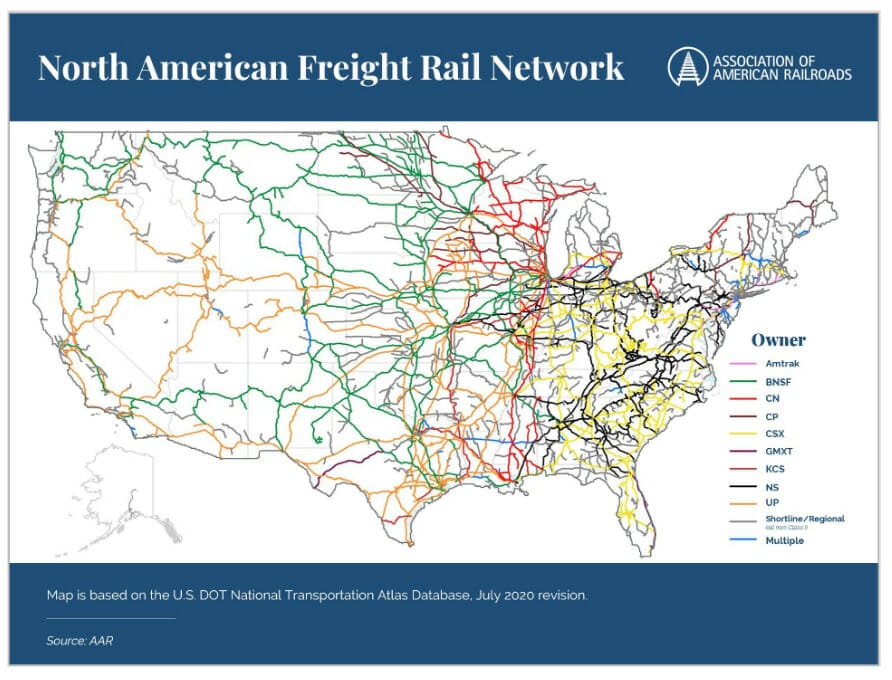
Freight Trains in USA, for comparison.
You’ve got plenty of trains and train lines, but your government, unlike most of the world, refuses to subsidise public transit, so they all go for the option that’s most profits-per-km, Freight
Another one I found:
Apparently this is a weak point for Europe, and even other rail systems like China’s. The US has a relatively efficient cargo rail network, while more stuff is shipped across the EU in trucks than it probably should be.
deleted by creator
Well, Electric Trucks are prevalent now, so still pretty efficient
Electric Trucks are prevalent now,
That would be nice, but only ~4% of the new trucks in the EU where electric in 2025. And there are a lot of old trucks which are almost exclusively ice-vehicles.
edit: source
Eh. I wasn’t specifically thinking of emissions, but overall cost, manpower, and road congestion.
Diesel cargo trains dramatically reduce all that vs an electric 18 wheeler, even if EV trucks are prevalent. Though I suspect they’re still pretty rare.
Yeah, UK is the worst train service in Europe, that’s nothing new.
That’s cause the UK privatised 90% of rail in the 1980s
Try Barcelona suburban rail service (aka ‘Rodalies RENFE’).
Here in Canada we have more former abandoned rail then active rail lines. And around where I am people are fighting to stop the old rail lines being used as biking and walking trails. YAY
I feel like many people oppose rails to trails because then there’s much less of a chance it will become rails again, so you have to let go of the hope of any sort of trains coming back. Though becoming a trail is certainly a lot better than the track land being split up and sold off to developers, since then there’s no chance.
Yeah, that is not at all the case here. There is no new passenger rail even as a dream and these rails used to be everywhere. We are talking about at least 40 years since a train was ever down these lines, and they have sat there doing nothing this whole time.
Funny thing, the UK we had the opposite problem, people fighting to stop the reopening of lines that have become walking and biking trails (usually for freight train profit)
We also converted many of our local innercity lines into into ELR, which is slower but it’s also cheaper and they’re all loop lines with a schedule of 1 every 5-10 minutes
I live in Jersey, and we have tons of them. And fortunately they are turning some into pedestrian paths, rails-to-trails style, but we have literal (albeit old) infrastructure for rail lines between places that are only accessible via rail by going to Newark, changing, and hopping on a different line. We’re talking hours for a 30 mile ride.
I need me some eminent domain. There’s some major hubs west of Newark that you can only drive between.
But yeah, seeing them turned into trails is at least better than nothing. But I want moooorrreee.
There are some trail networks in the eastern provances that allow people to go snowmobiling for weeks at a time on groomed trails (former rail lines) and I have known people that is what they did for their vacation each year, stopping in at all the small towns on the way.
Why ? that can’t be dangerous if no trains are running
Land owners have gotten used to just using the land for free, and they don’t want people near their land and other self serving things.
oh, ok. Landowner things I guess
Asshole landowner things yes.
deleted by creator
Situation in Europe is far from ideal. In most cases it’s cheaper to fly than to travel by rail across multiple country borders – which I’ve always found odd, considering the journey takes much longer and each connection brings some degree of uncertainty.
18 min delays aren’t uncommon. Or your train being outright cancelled, announced only in the local language (fair enough).
The whole system is chronically underfunded, probably in part thanks to the car lobby
I once heard of someone who had to go from somewhere in the south of England to London, and took a plane to Berlin and another to London because it was cheaper than the train.
I don’t understand why plane tickets are so cheap compared to plane tickets. Part of it is that plane fuel isn’t allowed to be taxed while other forms of energy are, but there’s got to be more. The situation is insane.
Anyway, let’s at least tax plane fuel.
That’s insane, especially considering Berlin is pretty deep into Germany. If it were Brussels or Schiphol – just a hop across the channel – I’d kind of get it.
Plane tickets have been getting more expensive. Recent (EU?) legislation places an extra tax on short-haul flights that would be 2h or less by train. The days of 30 EUR Ryanair flights seem to be a thing of the past. And the Epstein War has driven up prices for the foreseeable future.
Still cheaper to fly in most cases though.
Anyway, I’ve never been able to make up my mind about the right way forward. Make flying punishingly expensive so as to force travelers toward already expensive, but environmentally better alternatives? Or coordinate to reduce train ticket prices, e.g. through a system of subsidies? The latter is probably a lot harder to realize
Why not a balance between both? Use additional plane revenue to improve rail travel in the short- and middle-term?
The most ridiculous situation I came across was getting the train from Biarritz in France to Bilbao in Spain and back. I heard the phrase “It’s another country” uttered in both French and Spanish - turns out they really hate each other! We had to walk a few minutes from France across the border to another station in Spain.
Yup, I live in Warsaw, its hard to book sleeping train to Vienna. There are maybe 15-25 beds available everyday. In the meantime for the same prive or lower you can fly to Vienna. And probably more than 2000 people fly there
It’s cheaper to fly because of all the subsidies for flights
Is that US one real?
At best it’s inaccurate. I see several missing lines that I know exist because I lived near them.
Old map, perhaps?
More likely a new map, and the lines you’re thinking of have been shut down since the last time you checked.
(Or you’re thinking of train tracks in general, not specifically ones carrying passenger service, which is what this is a map of.)
Not that old. Between when Katrina wiped out the New Orleans-Jacksonville route in 2005 and when they partially restored the route in 2025. The only missing line I see is the Atlantic City line, which was out of service for about a week after Hurricane Sandy in 2012 and about 8 months for signal modernization work in 2018-2019, so it is probably an accurate map of the available services in late 2018. It’s worth noting that most of the lines on the map have one train per day per direction or fewer also, so if anything this map undersells the difference between US rail service and European rail service
I see several missing lines that I know exist because I lived near them.
It’s also missing every single rail line north of Copenhagen. The map is apparently a simplification on both continents.
Virginia, by any chance? I’m pretty there are state routes not on this Amtrak map
Or commuter rail? It’s hard to tell but I don’t see anything I recognize as commuter or metro rail. This looks like Amtrak intercity only.
All three state supported VA rail routes are on this map, along with the Cardinal, the Crescent, and the I-95 Amtrak routes. The S-Line isn’t, but it also doesn’t exist yet. Same with the Commonwealth Corridor. VRE shares tracks with Amtrak, so it is there, but does not have any visible effect on this map.
I think it’s only Amtrak, the main Intercity passenger rail service. There’s a ton more freight rail, and hundreds of smaller regional rail services.
It’s not just Amtrak, you can see Metra, LIRR, Metro North, and MBTA routes on the map around their respective cities. And I’m not convinced there are hundreds of regional rail services in America, maybe if you count heritage railroads, but even then I think you won’t be getting too far above 100 and those don’t actually take people from point A to point B generally, so it’s arguable that they count as passenger rail service
It’s worse than that, because it doesn’t show service level. The northeast corridor (Boston—>nyc—>dc) have great train frequency (even then they need to run more trains on holidays).
I believe the long distance routes are like one train per day. You’d have to be really dedicated or really desperate to deal with such slow unreliable trains which such low frequency. I do believe they’re there only to preserve track and collect votes rather than be useful. At this rate maybe in another century ….
For now yes, but the one from Oklahoma city to Fort Worth TX will be ending in 90 days.
The trains anywhere in the US except the Northeast are far too slow, infrequent, and unreliable to plan around. Delays frequently are measured in 10s of hours on Amtrak.
Europe is not a single country. Sadly things are not the same everywhere. South-eastern european countries still lack the infrastructure required for secure transport with trains.
Europe is not a single country.
Workin’ on it
deleted by creator
Please yes
deleted by creator
South Eastern European countries need to become less corrupt and a culture change, for sure. Then they can make headway in so many things.
Americans be like: Chicago
Overlaying the freight map over the passenger one is even more depressing
You have trains, a shitton, but “public transport isn’t profitable”
the only cool part is the cool place they all converge.
Chicago?
yesh. sweet home.
for some reason i always thought that the US is much larger than europe, but no, they’re roughly equal size.
The biggest difference between the United States and Europe is their respective population densities. Trains are less of a convenience and more of necessity. If everyone had a vehicle, it would be nearly impossible just to drive down the road.
Everyone support Murkan Cowboy Capitalism, and get out there and drive big clumsy SUVs!
wait till you see not only passenger trains but all trains lines in brazil, and for reference brazil is bigger than USA if you exclude Alaska and all random island USA owns
The funny thing is you look at the map and yeah it looks like we have less rail however overall we have more rail total.
US 136,729 miles
EU 124,895 miles
But I know neither one of these two also include light rail in here, narrow gauge rail, etc, which US does have quite extensively and it moves quite a few more people within the cities than cross the country.
Honestly this is why miles of rail is a pointless metric.
Number of people moved, how quickly, how far, how affordably, and distributed by population matter more.
I’ve lived in the US and Europe. Growing up in the US, the nearest public transit, a bus, was about 9 miles away. The roads did not have sidewalks for the vast majority of that and the roads were not designed for bikes. Essentially there was no available transit. If I somehow made it to this stop it would be another 1.5 hr bus ride with transfers to the nearest amtrak station. This wasn’t even the most rural part of the US. 8th most populous state in the country and about 20 miles from the 5th most populous city in that state.
I’ve yet to find anything like that anywhere in the country I’m currently in. Even going on hikes purposefully away from everything there’s still closer public transit than growing up.
I’ve been to plenty of places in the US where you wouldn’t find a bus stop for 50 miles.
And this isn’t even getting into how expensive and slow US rail is. That’s only talking about access.
Distance traveled is a huge thing. Also transit depends on where you live. In the city I live in there is a bus close to pretty much everywhere. They have last mile transit, light rail, and heavy rail as well,l. Servicing 1400 sq miles, 89 miles of light rail, 43 miles of heavy rail. That’s only one area here. I didn’t own a car for 9 years. In the 8 years since then the system has only gotten better, for example when I used to ride transit on Sundays there were only buses every hour and then they stopped after 5. That’s no longer the issue. Anyways. Honestly this argument of the US transit vs EU transit really doesn’t matter. They are far different places with far different needs. I can tell you that rail would work for some things, but definitely not every place.
Yes I’ve traveled to cities in the US as well, but that’s not what I’m saying at all.
These are not far different places with far different needs. Both people need transport. Both people need to get food, medicine, go to school, etc. However one group is significantly served while the other must rely on cars. If you lack the capital to access cars then you are destitute and practically locked into poverty. The percentage of the population with reasonable access to public transit ia significantly lower.
I’m not saying my old neighborhood need a rail connection per se, but it should have reliable transit that connects it to the major hub and provides rail access through that connection.
The US used to have this
The map only includes intercity passenger rail. Most of that 136,000 miles is freight rail that’s not on this map
People online claim we have a great freight rail network but I’m not convinced
- it’s heavily skewed toward bulk good like ore, that dont have a deadline or schedule, and very few shippers. Great efficiency numbers for spotty service
- we’re running on 100 year old infrastructure
- they’ve just let the rail rot, too often pulling up the second track or letting it get too rough for passenger rail
- they run ever larger trains, despite not building sidings big enough - cheaping out at the cost of delaying everyone else
Meanwhile in europe the TGV bombards at 320 kmh standard speed (or 350mph on fun days) while anemicans goes at 60…
Don’t compare dirt tracks to the autobahn!
Yeah, but we have Acela “high speed rail”
- meets the definition by traveling 150mph … for < 50 miles
- I think trip average Boston—>NYC is now up to 79mph
The Frontrunner in Utah runs up to 79mph. Not sure where you get caped at 60. It’s not the high speed. But for where it travels it’s fast
It was just a comparison, your trains are basically walking speed in comparison. Which means rail length in the us and europe isn’t comparable.
That was the gist of my post. Now good for you if you have fast trains and/or doesn’t need speedtrains.
Opel corsa?
Yes, the most American of cars, a small German hatch that isn’t sold in the US