The reason this works out that way is because there is a wage base for the social security tax. If you don’t make more than that base then you pay that tax all year long. If you’re making 1m then you pay that tax for like the first two months and then nothing afterwards. The solution to this is just removing the wage base. If you make 1m you should pay the same percentage as everybody else on all your earnings. Magically the social security system will be overfunded.
Explain please? It’s about the tax rate between those two? I thought the problem with CGT is that people dodge it by taking loans secured by their capital/stock. This does not seem to fix this problem…
LTCG means that I can 15% or 20% (depending on income) on selling stock even if I’m otherwise in a high tax bracket. Why should I get to have a massive tax break just because I already have a lot of income? There’s nothing special about my income from stock vs. my income from employment other than I work a hell of a lot harder for my income from employment than I do my income from stock.
Most people don’t have enough capital gains to tax. If they do have capital gains it’s either in there house and unrealized or in a retirement account and deferred. Raising the capital gains tax almost exclusively targets the wealthy, not necessarily billionaires but still top quintile.
Raising this rate could discourage investing.
What else are people going to do with there money then? Keep it in cash and lose even more of it to inflation then you would with the tax?
It provides incentive to keep your money in the market.
No it doesn’t. The vast majority of my stock has LTCG treatment. When I sell, I sell that stock because of the preferential tax treatment and let my non-qualified stock bake longer. You either have the wealth to be in the market and can play the game or you don’t and you’re not in the market. I’ve lived both lives.
Also, while paying my property tax bill, I noticed that the government has no problem taxing me for an assessed value of my property without me actually realizing my gains.
Of course, that is a property tax and not a capital gains tax, but it just shows that they definitely don’t have to wait until you sell to tax on capital gains. Just have an official assessment of value for investments.
Whoah, settle down there, buddy. Phase one is already sounding pretty far out there and I don’t trust things I don’t comprehend yet. Let me check my source…
…Okay. Fox News says I should be worried and so that’s what I’ll do. Nice try, ya commie bastard! And this is why I pay $8.99 a month to Rupert. Just saved me money.
TIL - interesting language… even the article goes on to call it a cap multiple times even though the official title is what you listed. Thanks for sharing!
With Social Security, the amount you get out is directly related to the amount you pay in. So if the cap is increased, yes, social security will get more income, but they’ll also need to start paying out a whole ton more.
It’s more of a forced savings/investment account than a wealth redistribution scheme. There is some redistribution happening, but not as much as most people think.
Social security benefits shouldn’t be proportional to income, it should be a set amount that everyone is eligible and it should be collected proportional to income including capital gains and everything else.
Social security paying retirement and disability payments is different from UBI. I am simply saying paying in should be proportional to income but the benefits should not.
A CEO and minimum wage worker should get the same social security benefits and they would be higher than they currently are if we taxed the Epstein class properly.
It’s a progressive payout though. SSA pays out 90 percent of average monthly income over 35 years (approximate based on their formula. AIME) below the first “bend” at about 1200 dollars per month, 32 percent between the first and second bend, and 15% above the second bend. So SSA would get 10.6 percent of every new dollar that used to be above the cap, while that dollar would increase the person’s benefit by their marginal rate (likely 32 or 15 for a high earner) divided by 420 months (you could assume the person will have a 35 year retirement to cancel out the two sides of the equation). Turning 10.6 percent into 15-32% (and most of the uncapped money would be likely to fall in the 15% if I had to guess) shouldn’t be a hard thing to do for SSA with extra funds to spare when you consider that the average retiree won’t live for a 35 year retirement and that there are 35 years of gains to capture between money in time vs money out time
except they mention paying a fraction of whats owed to some future pensioners. Why is it ok for them to pay in more than they get back but its somehow bad for someone of large means to pay in more they get back? Seems like a no brainer on how this should be handled to be equitable to society.
Removing the income cap is the obvious first step to balancing the social security budget, but it’s not enough to make the system solvent long term.
There are a number of ways to fix the remaining shortfall, but removing the cap is really the only easy measure and we can’t even do that. All others involve some amount of pain. This interactive calculator is worth spending a bit messing with: https://www.crfb.org/socialsecurityreformer/
But… If there cap is 184k, when you retire and get your SSI check, you won’t get more than the next person if you made 1m vs their 184k.
I think the point is the wealthy people are less likely to be reliant of SSI in retirement. So they don’t want to pay into it any more than they have to. If they paid more, they’d end up getting more, so while temporarily it’d be funded better sooner, SS would just pay more out later and still be broken.
And so what? If I pay taxes and never use WIC, is that wrong in some way?
Social Security also funds SSI disability, most of us won’t use that but we pay for it. That’s how taxes work.
The cap should be removed, it’s a tax not a pension plan. We can cap the benefits (higher than it is now) without capping the deduction. Anyone making $1M/year is still going to net hundreds of thousands more than someone making $200K. And both of them will be fine.
If you are reforming SS to raise the cap, why wouldn’t you also reform the payment end as well? There is no reason that the wealthy should get enormous SS payments they don’t need, and allow that to cripple SS for those who do need it.
I can hear the parasites now: “It isn’t fair! The poors get all the breaks!”
The answer is that no, we don’t have to pay out enormous sums of social security to rich people. Right now the benefit varies but that is not a necessary part of the scheme. Just like we set a maximum contribution now, we can set a maximum benefit.
No matter how you slice it, the problem right now is that people raking in $ are not paying enough into the system.
Or set maximum monthly payout, adjusted annually for inflation and let the actuaries figure out where the wage cap needs to sit each year to fully fund the system.
Over funded how? Right now they still collect social security. Are you suggesting they should pay more into SS and then collect less to turn it into a tax?
They do. SS is not a tax. It’s a required investment plan. The reason it’s skewed in percentage is because it maxes out and is shown relative to their income. Just raise taxes the proper way.
What does honorable mean in this context? Pay in on what you earn, that’s all. That would be honorable. If you make millions, why do you care? Your retirement is safe either way, help others have at least a little security.


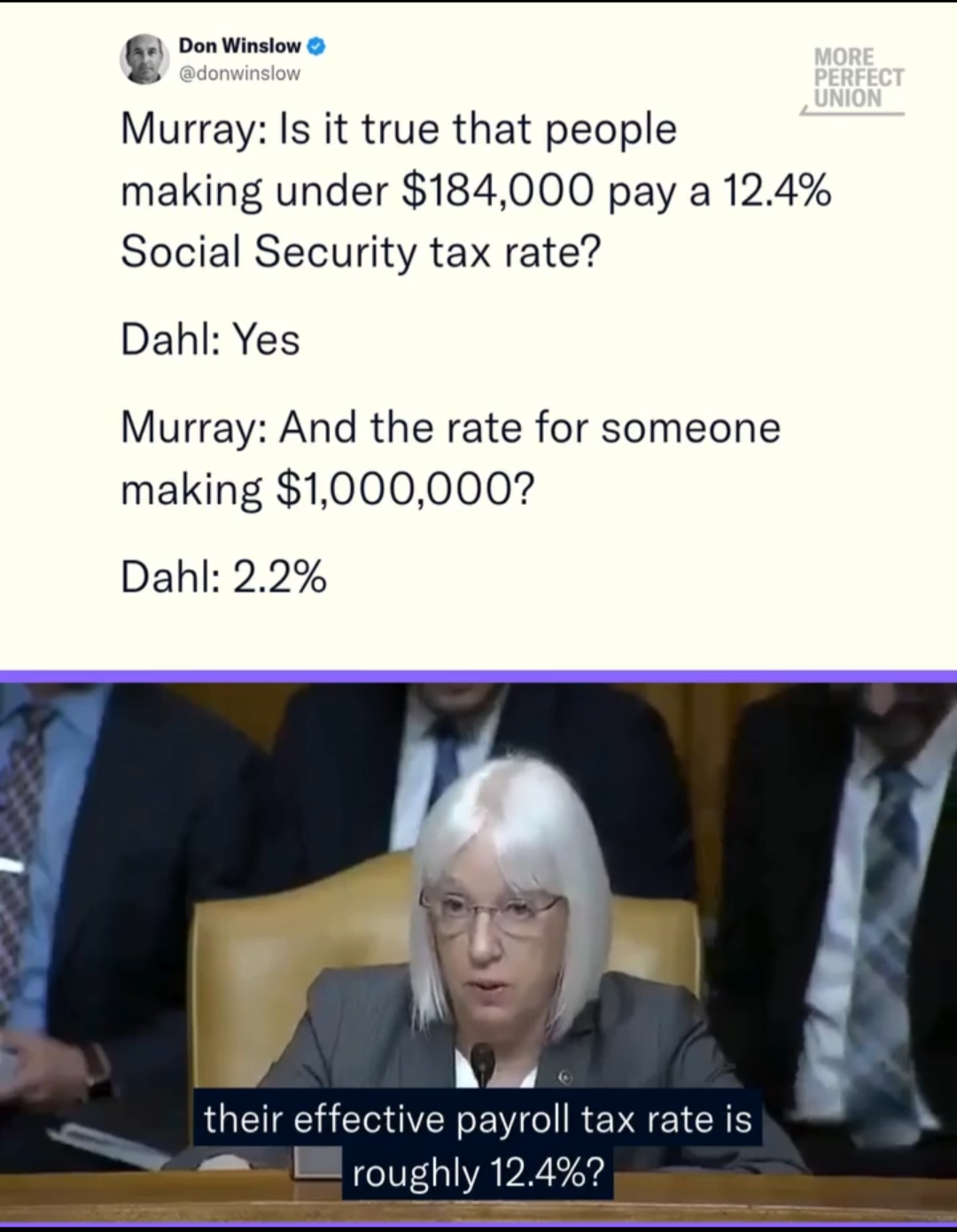
The reason this works out that way is because there is a wage base for the social security tax. If you don’t make more than that base then you pay that tax all year long. If you’re making 1m then you pay that tax for like the first two months and then nothing afterwards. The solution to this is just removing the wage base. If you make 1m you should pay the same percentage as everybody else on all your earnings. Magically the social security system will be overfunded.
The other thing to get rid of is long term capital gains taxes and just tax capital gains as regular income.
Explain please? It’s about the tax rate between those two? I thought the problem with CGT is that people dodge it by taking loans secured by their capital/stock. This does not seem to fix this problem…
LTCG means that I can 15% or 20% (depending on income) on selling stock even if I’m otherwise in a high tax bracket. Why should I get to have a massive tax break just because I already have a lot of income? There’s nothing special about my income from stock vs. my income from employment other than I work a hell of a lot harder for my income from employment than I do my income from stock.
0% if your taxable income is under $96,700 as a married, filing jointly household.
“Normal” people do not avoid paying these taxes by taking loans with their accounts as collateral. That applies only to multi-billionaires.
Most people pay a lower tax rate on long-term capital gains as compared to income. Raising this rate could discourage investing.
Most people don’t have enough capital gains to tax. If they do have capital gains it’s either in there house and unrealized or in a retirement account and deferred. Raising the capital gains tax almost exclusively targets the wealthy, not necessarily billionaires but still top quintile.
What else are people going to do with there money then? Keep it in cash and lose even more of it to inflation then you would with the tax?
The point of long term capital gains tax is so people don’t just yank money out all the time. It provides incentive to keep your money in the market.
That said, making the ltcg tax just 2% less than your income tax seems better than a flat 13% or whatever it is.
No it doesn’t. The vast majority of my stock has LTCG treatment. When I sell, I sell that stock because of the preferential tax treatment and let my non-qualified stock bake longer. You either have the wealth to be in the market and can play the game or you don’t and you’re not in the market. I’ve lived both lives.
Also, while paying my property tax bill, I noticed that the government has no problem taxing me for an assessed value of my property without me actually realizing my gains.
Of course, that is a property tax and not a capital gains tax, but it just shows that they definitely don’t have to wait until you sell to tax on capital gains. Just have an official assessment of value for investments.
So what you’re saying is, social security should be, like…social?
It’d also be nice if it offered actual security.
Whoah, settle down there, buddy. Phase one is already sounding pretty far out there and I don’t trust things I don’t comprehend yet. Let me check my source…
…Okay. Fox News says I should be worried and so that’s what I’ll do. Nice try, ya commie bastard! And this is why I pay $8.99 a month to Rupert. Just saved me money.
We’re talking about a cap and not a base, but yeah… remove the cap and everything gets better.
That’s effectively what it is but it’s called the social security wage base.
TIL - interesting language… even the article goes on to call it a cap multiple times even though the official title is what you listed. Thanks for sharing!
Welcome to American politics: where the rules are made up and the words don’t matter
With Social Security, the amount you get out is directly related to the amount you pay in. So if the cap is increased, yes, social security will get more income, but they’ll also need to start paying out a whole ton more.
It’s more of a forced savings/investment account than a wealth redistribution scheme. There is some redistribution happening, but not as much as most people think.
Social security benefits shouldn’t be proportional to income, it should be a set amount that everyone is eligible and it should be collected proportional to income including capital gains and everything else.
That’s a UBI, not Social Security. It’s a great idea! But it’s not Social Security.
If that were UBI then I would get paid before I was 67.
Social security paying retirement and disability payments is different from UBI. I am simply saying paying in should be proportional to income but the benefits should not.
A CEO and minimum wage worker should get the same social security benefits and they would be higher than they currently are if we taxed the Epstein class properly.
It’s a progressive payout though. SSA pays out 90 percent of average monthly income over 35 years (approximate based on their formula. AIME) below the first “bend” at about 1200 dollars per month, 32 percent between the first and second bend, and 15% above the second bend. So SSA would get 10.6 percent of every new dollar that used to be above the cap, while that dollar would increase the person’s benefit by their marginal rate (likely 32 or 15 for a high earner) divided by 420 months (you could assume the person will have a 35 year retirement to cancel out the two sides of the equation). Turning 10.6 percent into 15-32% (and most of the uncapped money would be likely to fall in the 15% if I had to guess) shouldn’t be a hard thing to do for SSA with extra funds to spare when you consider that the average retiree won’t live for a 35 year retirement and that there are 35 years of gains to capture between money in time vs money out time
except they mention paying a fraction of whats owed to some future pensioners. Why is it ok for them to pay in more than they get back but its somehow bad for someone of large means to pay in more they get back? Seems like a no brainer on how this should be handled to be equitable to society.
Removing the income cap is the obvious first step to balancing the social security budget, but it’s not enough to make the system solvent long term.
There are a number of ways to fix the remaining shortfall, but removing the cap is really the only easy measure and we can’t even do that. All others involve some amount of pain. This interactive calculator is worth spending a bit messing with: https://www.crfb.org/socialsecurityreformer/
But… If there cap is 184k, when you retire and get your SSI check, you won’t get more than the next person if you made 1m vs their 184k.
I think the point is the wealthy people are less likely to be reliant of SSI in retirement. So they don’t want to pay into it any more than they have to. If they paid more, they’d end up getting more, so while temporarily it’d be funded better sooner, SS would just pay more out later and still be broken.
And so what? If I pay taxes and never use WIC, is that wrong in some way?
Social Security also funds SSI disability, most of us won’t use that but we pay for it. That’s how taxes work.
The cap should be removed, it’s a tax not a pension plan. We can cap the benefits (higher than it is now) without capping the deduction. Anyone making $1M/year is still going to net hundreds of thousands more than someone making $200K. And both of them will be fine.
If you are reforming SS to raise the cap, why wouldn’t you also reform the payment end as well? There is no reason that the wealthy should get enormous SS payments they don’t need, and allow that to cripple SS for those who do need it.
I can hear the parasites now: “It isn’t fair! The poors get all the breaks!”
I was asking a serious question, not defending the wealthy.
The answer is that no, we don’t have to pay out enormous sums of social security to rich people. Right now the benefit varies but that is not a necessary part of the scheme. Just like we set a maximum contribution now, we can set a maximum benefit.
No matter how you slice it, the problem right now is that people raking in $ are not paying enough into the system.
Or set maximum monthly payout, adjusted annually for inflation and let the actuaries figure out where the wage cap needs to sit each year to fully fund the system.
Over funded how? Right now they still collect social security. Are you suggesting they should pay more into SS and then collect less to turn it into a tax?
Pay their fair share is what it is called.6
They do. SS is not a tax. It’s a required investment plan. The reason it’s skewed in percentage is because it maxes out and is shown relative to their income. Just raise taxes the proper way.
Yes.
Why not raise taxes instead of ruining a honorable program?
What does honorable mean in this context? Pay in on what you earn, that’s all. That would be honorable. If you make millions, why do you care? Your retirement is safe either way, help others have at least a little security.
YES