
Chlorophyll Powered Apple Magic Mouse
There are too many people to live in a way other than agrarian at this point.
“Agrarian”, rather than “agricultural”, usually refers to a society that is oriented around rural agriculture by smallholders in opposition to urban civilization.
I’m biased against urban agriculture since it caused all of the problems humanity has been beset with for the last 10,000 years. Maybe if there was some kind of check against a city that starts using its massive resources to be predatory on less defensible communities as they always have.
I’m biased against urban agriculture since it caused all of the problems humanity has been beset with for the last 10,000 years.
That’s… an extremely questionable analysis.
What’s the most obvious question?
Either that cities have only really been around for ~5000 years, and that’s with a generous definition of ‘city’ and a very broad swathe of the world not having cities entirely for thousands of years after that; or that rural and agrarian-dominated societies historically have experienced most of the same core issues that urban-dominated civilizations have.
The problems shared by cultures according to historical records are the problems of cities I’m talking about. Whether you would call them cities or not, among the fertile crescent civilizations there were definitely empires and there have been empires ever since. The written records history is based on are more modern than either empires or agriculture. I struggle to think of any issue which exists in my lifetime which was not caused in some way by the effects of empires.
Agriculture is the enabling factor for empires, so in my opinion agriculture must be practiced in a deliberate way which prevents the formation of empires. To this end I think people living intentionally in agrarian communities which minimize the burdens of regular life is less likely to plant the seeds of caste and hierarchy than a community in which people are alienated from the influence of their labor or have weaker connections to the people sustaining their lives.
The problems shared by cultures according to historical records are the problems of cities I’m talking about. Whether you would call them cities or not, among the fertile crescent civilizations there were definitely empires and there have been empires ever since. The written records history is based on are more modern than either empires or agriculture.
You do realize, though, that historical records cover non-agricultural and non-imperial societies, right?
I struggle to think of any issue which exists in my lifetime which was not caused in some way by the effects of empires.
… I struggle to think of any condition, positive or negative, that exists in our lifetime which was not caused in some way by the effects of what you call ‘empires’.
Agriculture is the enabling factor for empires, so in my opinion agriculture must be practiced in a deliberate way which prevents the formation of empires.
Agriculture is the enabling factor for empires, because agriculture is the enabling factor for reliable human existence in most areas. Pastoralism has created empires, and even hunter-gathering in some very exceptionally bountiful regions. As soon as populations become geographically and demographically stable enough to form long-term relations with one another, imbalances form; and without ideological preconceptions against hierarchy, so too do hierarchies form.
To this end I think people living intentionally in agrarian communities which minimize the burdens of regular life is less likely to plant the seeds of caste and hierarchy than a community in which people are alienated from the influence of their labor or have weaker connections to the people sustaining their lives.
Agrarian communities and cultures, historically speaking, are often very hierarchical, and heavily conformist to boot. You’re imagining a very urban and modern worldview as transplanted wholesale into distinctly urban-and-modernity-hostile material conditions. You talk as though stronger connections with people is a kumbaya moment, but stronger connections with people is very often more Jante’s Law than Friendship is Magic.
That would be the best possible future
Labellian labellerism labelizer
@PugJesus what exactly about cultivating the land do you not approve of? that’s all agrarian means
There’s a lot of romanticizing of agricultural work, and while some people might like “back to the land”-style communal agrarian societies, there’s also plenty of people who dont want to be farmers just for the aesthetic.
I’m happy to live in a society with a whole lot of non-farming jobs (even if personally, I really wish I had the land and time to hobby farm).
Agriculture is specifically the cultivation of acres; i.e. fields of crops.
It’s an inefficient and ecologically devestating form of food production compared to food forests and gardening. It results in structural nutritional deficiencies (e.g. half the western world being overweight because staple crops are short on particular minerals and vitamins unless you eat way too many calories) and the occasional massive famines.
The one upside it has - labor efficiency - is predicated on poisoning the earth. Rather than figure out what plants need they flush the earth with chemicals and poisons and pump aquifers dry, throwing enough stuff at the problem that they don’t need people as much.
… none of that is correct.
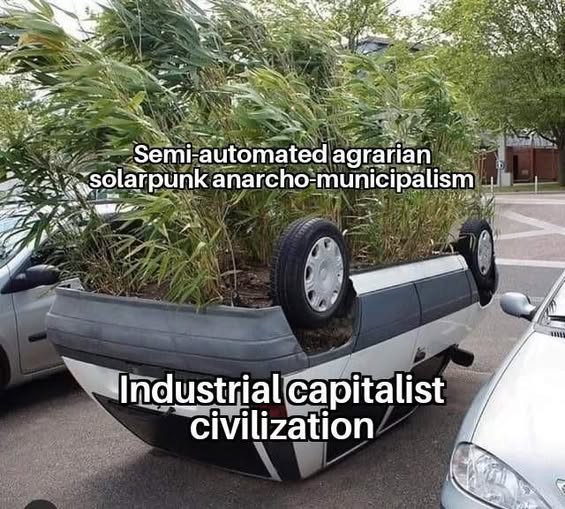
This is the best way to use a car.
#ZeroCarz