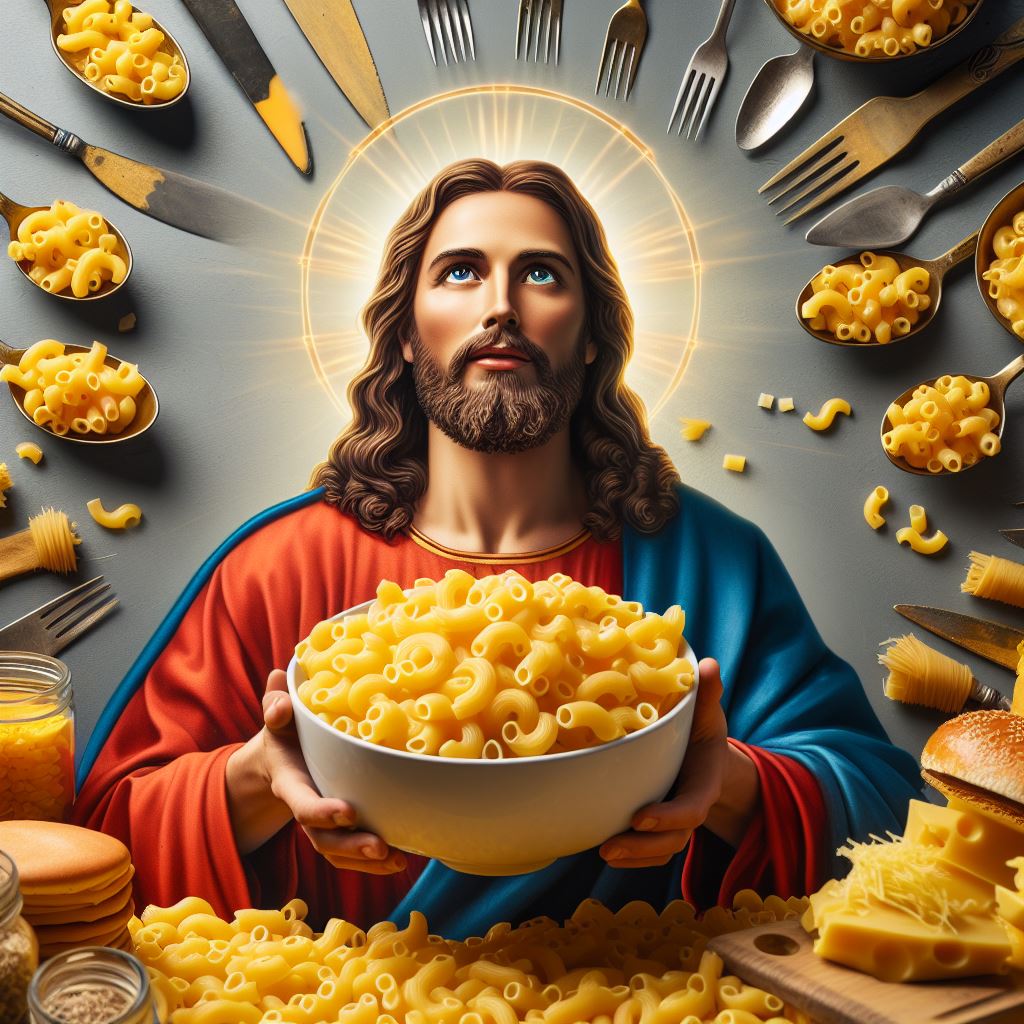
I’m imagining a set of big naturals
Real
But that is smaller than the naturals
I just imagined it? Now what?
Well now you just triggered a false vacuum decay on the far side of the galaxy. Way to go.
Now write a proof showing that your set is neither countably nor uncountably infinite and become the most famous mathematician I’ve replied to on Lemmy today
No, it’s private. You have no right to the things I imagine and that wasn’t the deal!
I have discovered a truly marvelous proof of this, which this
margincomment is too narrow to contain.The proof of this has been left to the reader…

The limit is trying to be 100% unique and novel.
Like, try to imagine a creature that has 0 inspiration from everything you know about real life. Even Lovecraft never came up with things that were entitely alien to the human mind, despite that kinda being the whole point (other than the racism).
Sounds like you’re asking the human brain to fire in a pattern it’s not even wired for. Random noise in the web, or even definitionally impossible as “totally alien” might imply a configuration of neurons opposite of what we have. I feel like I’m having a hard time describing my thought here.
xighfkfutjgihugkghjgkckggdjjxubkctqjfhghhkhmhkhnvkcjfgrgshhgjdkguhjfjejtjgjffkcufjgjtiritu
Okay i did it, now what
You used english characters. Disqualified.
Please translate.
the cardinality of a set is the number of things in it.
some sets have infinite items in them such as the counting numbers (there’s always a bigger fish dot jpeg). but not all infinities are equal some are larger.
equality: if we can map a 1:1 rule between items in two sets with infinite items they are said to be equal infinities.
greater: but if we can map all in one set to another and note that there are still items left over, the first set has more things in it so if the other set has infinity items in it, this collection must have an even larger set of items in it, a greater tier of infinite.
a common example in math classes is mapping items in the real number between 0 and 1 to the counting numbers (1,2,3,…) using the rule 1>1/1, 2>1/2, 3>1/3,… we can see (0 to 1) has a 1:1 mapping but there are still more items (for instance 1/1.5). this shows there are more items in the real number line from 0 to 1 than there is items in the counting numbers. though both are infinite one infinity is larger.
so the meme. it’s asking you to imagine a collection items that has greater number than the counting number infinity, but less than the next tier of infinity, those in the real number line. something which is hard to imagine because if it were easy we would have plugged that infinity tier into our tiering system.
Thanks!
Imagine a 4D object if you think human imagination is limitless. Good luck
You can project a 4D object onto a 3D space just like you can project a 3D object onto a 2D plane. If you use stereoscopic trickery you can for example watch a tesseract rotate on a phone screen. Don’t ask me how I know but if you spend an evening doing that sorta thing on shrooms 4D geometry might start feeling intuitive to you. Your physical senses are limited to three dimensions, your mind genuinely isn’t.
.
Ok I did. Im just built different.
x ∈ ℝ⁴, there done
edit: if you want specifics, (1, 2, 3, 4)
moves a cube
deleted by creator
That actually sounds awesome. I’d pay to go to that show.
Georg Cantor in shambles.
What about all reals > 0?
Same as the cardinality of all reals. In fact, the cardinality of the set of all reals between 0 and 1 is the same as the cardinality of the set of all reals. https://en.wikipedia.org/wiki/Cardinality_of_the_continuum#Sets_with_cardinality_of_the_continuum
Glad you made me look! I hadn’t thought about whether there were sets with cardinality greater than the cardinality of the continuum. https://en.wikipedia.org/wiki/Cardinality_of_the_continuum#Sets_with_greater_cardinality
Maybe I would if my spare brain capacity wasn’t being used to rotate cows.
Just imagine them invariant to any 3D rotation.
Great, now I’m imaging a universe rotating around a stationary cow.
There are more rational numbers than natural numbers.
Prove this by noting that every natural number is rational but not every rational number is natural.There are more real numbers than rational numbers. Prove this by noting that every rational number is real but not every real number is rational.
Checkmate meme.
The problem is that rational numbers can be mapped (1 to 1) to the integers (e.g. just encode each rational number as an integer), so there are not more rational numbers than integers.
No that’s not true. There are rational numbers in between the integers and all integers are rational. Therefore the mapping from integers to rational numbers is injective and thus there are more rational numbers than integers.
“the” mapping? there is no “the” mapping.
you are talking about the canonical inclusion mapping 1 in N to 1 in Z (restriction of the canonical inclusion of rings of integers Z into any other ring, Z is an initial object), which can be seen as a non-generic canonical mapping of semigroups.
but as sets, there is no inherent structure, there are injection, surjections, and of course bijections in both directions.
the only way one can call one set “bigger” is in the very strict sense of sets, N being a true subset of Q. however, this assumes N to be an actual subset of Q, which is a matter of definition and construction. so we say there is some embedding included, which is the same as (re)defining N as that embedded subset, so we are at your canonical inclusion of semigroups again. if you view this as inherent to N and Q, then there are “more” elements in Q as in N, but not in terms of cardinality.
transfinite hocuspocus bullshit is what it is
Well, there are more integers than naturals, yet both share the same cardinality. Also, I thing hilbert’s hotel problem shows that rationals and naturals also share the same cartinality, somehow. You could arrange every rational in a line like the naturals and the integers.
But well tried, outstanding move.
That’s not how cardinality works when dealing with infinite. For ex, there are the same number of prime number than number of integer. Yes, there are many non prime inter between 2 prime integer, but as long as you can “count” them, they have the same cardinality, which is called “aleph 0”.
But you cannot “count” real number. There are actually more real between 0 and 1 than there are interger. This value is called “aleph 1”.
Yes, there is also aleph 2, aleph 3,… There is not a single “infinite”, but there are several one that don’t have the same size.
Have a look to Hilbert’s hotel paradox https://en.wikipedia.org/wiki/Hilbert’s_paradox_of_the_Grand_Hotel
Another way of stating the difference between natural vs. real sets is that you can’t count every real number. What’s in between? A set where you can count some significant portion?
Are you saying that there’s nothing in between? Prove it, and turn modern mathematics inside out!
The set of Real numbers excluding the Naturals
Edit: before anyone says i know that that’s still the same cardinality as the reals.
Correct me if.I’m wrong but the Continuum Hypothesis was proven undecidable. So we can chose to add CH (false or true, whichever we like) to ZFC without changing anything meaningful about ZFC.
But then, if we chose it to be true, could we construct such a set ?
If you could construct such a set, CH wouldn’t be independent of ZFC
Thanks for the insight !
deleted by creator
Olo is a good example. It’s due to a quirk of human perception and the structure of our eyes. They basically designed a machine to try and stimulate the green detecting cones without stimulating the red detecting cones. Normally if something pure green hits your eyes, it stimulates those red cones too. So this is something our bodies are capable of perceiving but not something that we can ever perceive under normal circumstances.
Is it a “new color”? Not exactly. Did it take a good bit of imagination to conceive trying to get our brains to see it? Yes.
That’s wild. So the only people who have seen olo are ones who’ve had their eyes laser beamed.
deleted by creator